

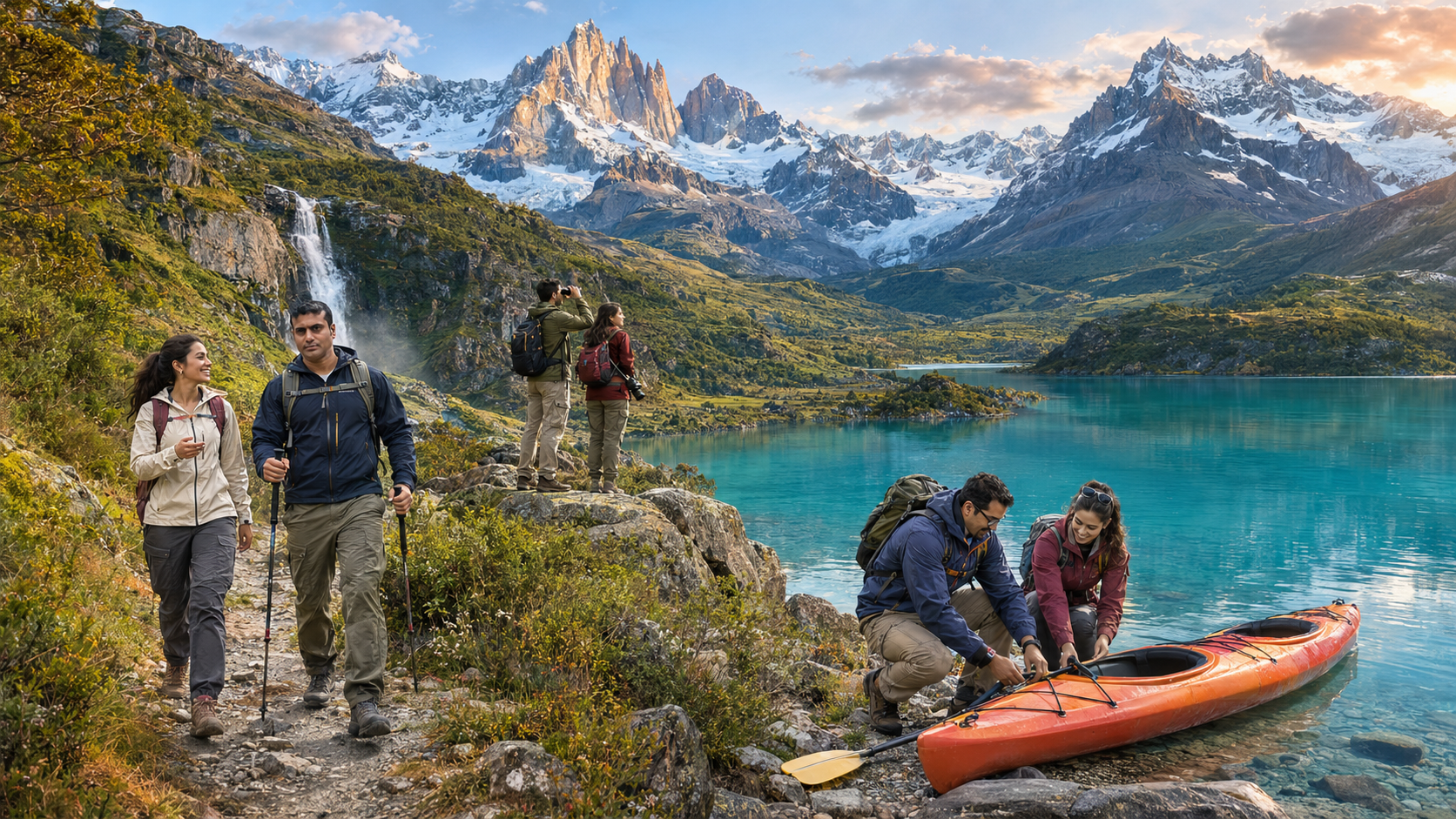

There is nothing wrong with spending a week beside a beautiful beach.
The problem begins when both people are secretly bored by lunchtime on day three.
Some couples relax by lying still. Others relax by hiking somewhere difficult, kayaking beneath mountains, getting soaked on a rafting trip, driving a road neither has seen before, or returning to the hotel exhausted enough that dinner tastes twice as good.
Those couples need a different vacation.
The best adventure vacations for couples still leave room for romance. They simply replace the assumption that romance requires seven consecutive days beside an infinity pool.
Current travel coverage reflects that shift. Condé Nast Traveler’s 2026 couples guide specifically highlights destinations where partners can mix romance with experiences such as canyoning, hiking, wildlife watching and mountain adventures rather than staying entirely resort-based.
The sweet spot is not constant adrenaline.
It is a trip where you do something memorable together during the day and still have somewhere excellent to eat, drink, recover or slow down afterward.
These destinations get that balance right.
Best Adventure Vacations for Couples at a Glance
| Destination | Best Adventure | Intensity | Ideal Trip | Best Time |
|---|---|---|---|---|
| Queenstown & South Island, New Zealand | Hiking, rafting, kayaking, bungy | Medium–High | 10–14 days | Nov–Apr |
| Costa Rica | Rafting, ziplining, surfing, wildlife | Medium–High | 8–12 days | Region dependent |
| Patagonia, Chile & Argentina | Trekking, glaciers, road trips | High | 10–14 days | Nov–Mar |
| Iceland | Hiking, glaciers, road trips | Medium | 7–10 days | Jun–Sep |
| Banff & Canadian Rockies | Hiking, canoeing, skiing | Medium | 7–10 days | Jun–Sep / winter |
| Madeira, Portugal | Levada hiking, canyoning | Medium | 5–8 days | Apr–Jun, Sep–Oct |
| Peru | Trekking, archaeology, mountains | High | 10–14 days | May–Sep |
| Slovenia | Hiking, rafting, cycling | Medium | 7–10 days | May–Sep |
| Dominica | Canyoning, diving, waterfalls | Medium–High | 6–9 days | Feb–May |
| Japan | Hiking, skiing, cities, culture | Low–High | 10–14 days | Spring/fall/winter |
1. Queenstown and New Zealand’s South Island — Best Overall
If you want one destination that can turn almost any couple into an adventure couple, start with New Zealand.
Queenstown has built an entire identity around doing things that make sensible people ask questions.
Bungy jumping.
Jet boating.
Rafting.
Skydiving.
Mountain biking.
Then, when you have had enough adrenaline, the landscape keeps going.
New Zealand’s official tourism organization describes Queenstown as an adventure hub for bungy, jet boating and rafting, but also highlights hiking, cycling, wineries, dining and spas. That combination is exactly why it works so well for couples.
You can spend several days around Queenstown, then move toward:
Wanaka,
Fiordland,
Milford Sound,
and perhaps the Routeburn Track.
One day can involve kayaking beneath cliffs.
The next can be a wine tasting.
That variation matters.
A relationship should probably not be tested exclusively through activities involving helmets.
Best for: Couples who want variety and excellent infrastructure.
Ideal trip: 10–14 days.
Official planning: New Zealand Tourism — South Island Adventure
2. Costa Rica — Best for Adventure Without Complicated Logistics
Costa Rica may be the easiest tropical destination for couples who want to stay active.
The landscape does most of the planning for you.
Volcanoes.
Rainforest.
Rivers.
Cloud forest.
Pacific surf.
Caribbean coastline.
Official Costa Rica tourism guidance lists white-water rafting, kayaking, surfing, diving, hiking, canyoning and ziplining among the country’s core adventure experiences.
A strong couples itinerary could look like:
Arenal ? Monteverde ? Pacific coast.
Around Arenal, combine volcano scenery, hiking and rafting with hot springs at night.
Monteverde adds cloud forest, hanging bridges and zip lines.
Finish around Santa Teresa or another Pacific destination where the final few days can mix surfing with actual downtime.
That is the formula I like most:
adventure first, slower finish second.
Costa Rica also handles different comfort levels well. One person can tackle serious rafting while the other chooses hiking, wildlife or hanging bridges without feeling as though they booked the wrong vacation.
Best for: First adventure trip as a couple.
Official planning: Visit Costa Rica — Adventure Travel
3. Patagonia — Best for Couples Who Want a Real Expedition
Patagonia is not the vacation I would choose to discover whether your partner likes hiking.
Know that before booking.
If you both do, however, this is one of the great trips.
Torres del Paine in Chile gives you granite towers, turquoise lakes, huge skies, glaciers and the famous W and O trekking circuits. Chile’s official tourism authority describes the park as roughly 227,000 hectares of mountains, forest, lakes and steppe, with the W Circuit, O Circuit and Grey Glacier among its defining experiences.
Across the border in Argentina, El Chaltén adds exceptional day hiking around Fitz Roy, while El Calafate opens access to Perito Moreno Glacier.
You can do Patagonia in relative comfort.
Excellent lodges exist.
So do guided hikes and private transfers.
But the weather remains Patagonia.
Wind does not care how much the hotel cost.
That unpredictability is part of the appeal.
Best for: Experienced hiking couples and milestone trips.
My recommendation: Don’t change hotels every night. Give major areas several days so weather can rearrange the itinerary.
Official planning: Chile Travel — Torres del Paine
4. Iceland — Best Adventure Road Trip for Two
Iceland may be the ultimate couples road trip because you spend much of the vacation solving tiny decisions together.
Stop here?
Walk there?
Take this road?
Eat now?
Photograph another waterfall?
Yes. Apparently always another waterfall.
The Ring Road gives the trip a natural structure, while side trips add:
glacier hiking,
hot springs,
volcanic landscapes,
black beaches,
waterfalls,
horse riding,
and mountain trails.
Visit Iceland describes the country as an outdoor destination built around mountains, volcanoes, glaciers, rivers and rough terrain, with hiking ranging from short nature walks to multi-day wilderness routes.
For adventurous couples, I would choose summer unless northern lights are the main priority.
Long daylight makes spontaneous driving easier.
You can then add a guided glacier experience rather than attempting technical glacier travel independently.
Best for: Couples who like freedom more than rigid tours.
Adventure level: Easy to customize from very soft to quite serious.
5. Banff and the Canadian Rockies — Best for Mountain Adventure With Comfort
Some adventure destinations require you to sacrifice comfort.
Banff does not.
That is exactly why couples love it.
You can hike above Lake Louise during the day and end the evening somewhere with excellent food, a spa and a proper bed.
Condé Nast Traveler’s current couples guide highlights Banff for hiking, canoeing, skiing and skating, while still emphasizing the region’s romantic mountain hotels and slower experiences.
A strong itinerary combines:
Banff,
Lake Louise,
the Icefields Parkway,
and Jasper when conditions and access allow.
In summer, hike and canoe.
In winter, ski, skate and use the mountains differently.
The Rockies also work well when one partner is more adventurous than the other because the scenery does not require extreme activity to enjoy.
One can take the longer trail.
The other can choose a shorter route.
You still meet for dinner.
A useful relationship structure.
6. Madeira — Best European Adventure Island
Madeira is technically an island vacation.
It simply refuses to behave like one.
The Portuguese island rises sharply from the Atlantic, creating mountain roads, cliffs, forest, waterfalls and an extraordinary network of levada trails.
For couples, Madeira is especially strong because you can build an active day without needing an expedition-level commitment.
Hike.
Canyon.
Drive mountain roads.
Swim in natural pools.
Take a cable car.
Then eat seafood looking over the ocean.
It is adventurous without becoming logistically exhausting.
This makes Madeira one of the strongest alternatives for couples who like the idea of an island but have no desire to remain at a resort all week.
Best for: Hiking couples who still want restaurants, hotels and easy evenings.
Ideal trip: Five to eight days.
7. Peru — Best for Adventure Plus Culture
Peru has something many adventure destinations lack:
the physical challenge is only half the reason to go.
The other half is history.
Cusco and the Sacred Valley provide the cultural framework.
The Andes provide the landscape.
Machu Picchu gives the trip an obvious centerpiece.
Couples can choose the classic Inca Trail, alternative trekking routes, mountain biking, rafting or shorter hikes depending on fitness and time.
Altitude is the complication.
Do not arrive in Cusco and schedule your hardest activity immediately because your normal fitness level has convinced you the Andes will negotiate.
They will not.
Spend time acclimatizing.
Then build upward.
Best for: Couples who want their adventure mixed with food, culture and archaeology.
Ideal trip: 10–14 days.
8. Slovenia — Best Underrated Adventure Trip in Europe
Slovenia is what happens when you combine Alps-level scenery with manageable distances.
You can move between:
Ljubljana,
Lake Bled,
Triglav National Park,
the So?a Valley,
and wine country
without dedicating half the vacation to transfers.
For couples, the So?a Valley is especially strong.
The river’s striking color gives rafting and kayaking an unusually beautiful setting, while the surrounding mountains support hiking and cycling.
The trip also has an excellent rhythm.
Adventure during the day.
A small town, wine region or good restaurant in the evening.
Slovenia works particularly well for couples who want Europe but do not want their trip dominated by major-city crowds.
Best for: Road trips, moderate adventure and active first-timers.
9. Dominica — Best Caribbean Destination for Couples Who Get Bored on Beaches
Dominica is the answer to a specific question:
What if we want the Caribbean but don’t want to spend seven days doing Caribbean-resort things?
The island is mountainous, green and built around activity.
Condé Nast Traveler’s 2026 couples guide recommends Dominica specifically for thrill-seeking pairs, highlighting canyoning, waterfalls, hiking, diving, kayaking and thermal waters.
You can hike around volcanic terrain in Morne Trois Pitons National Park, rappel through canyons or dive offshore.
And yes, beaches exist.
They simply are not the entire sales pitch.
That makes Dominica particularly useful for couples where one person wants tropical scenery and the other starts getting restless after twenty minutes on a sun lounger.
Best for: Caribbean adventure without abandoning romance.
10. Japan — Best for Couples Who Define Adventure More Broadly
Adventure does not always require a harness.
Sometimes it means navigating a country together where every day feels different.
Japan allows you to mix:
Tokyo,
Kyoto,
mountain hiking,
onsen towns,
cycling,
skiing,
food,
trains,
and rural landscapes
within one trip.
Condé Nast Traveler currently recommends Tokyo for curious, active couples who prefer exploring neighborhoods, food and cultural experiences over passive resort travel.
But the stronger adventure itinerary goes beyond Tokyo.
Add the Japanese Alps.
Walk part of the Nakasendo route.
Stay in a ryokan.
Travel north for skiing in winter.
Or build a hiking-focused trip around Kyushu or Hokkaido.
The advantage is that Japan still works beautifully when bad weather cancels the outdoor plan.
There is always another train, museum, neighborhood or bowl of ramen.
Best for: Couples who want discovery more than adrenaline.
How to Choose an Adventure Vacation as a Couple
The biggest mistake is choosing based on the more adventurous person.
That creates a spectacular trip for one person and a hostage situation for the other.
Instead, each person should privately rate activities from one to five:
1 — absolutely not
through
5 — I would book the flight for this
Compare the answers.
You do not need identical scores.
You need enough overlap.
If one person rates multi-day trekking a five and the other rates it a one, Patagonia’s W Trek is probably not relationship therapy.
Costa Rica or New Zealand may work better because both partners can choose different levels of intensity.
Use the 60/30/10 Rule
For most couples, I would design an active vacation like this:
60% shared adventures
Activities both people genuinely want.
30% recovery and unstructured time
Restaurants, spas, slow mornings, wandering, wine, hot springs.
10% individual choice
One partner dives while the other gets a massage.
One tackles the big hike while the other chooses the shorter route.
You do not have to experience every minute together for the trip to count as romantic.
In fact, eight straight days of forced togetherness may be more adventurous than anything on this list.
Soft Adventure vs Hard Adventure
This distinction matters.
Soft adventure includes activities such as:
easy hiking,
kayaking,
wildlife trips,
cycling,
road trips,
snorkeling,
and guided beginner rafting.
Harder adventure may involve:
multi-day trekking,
technical climbing,
advanced rafting,
serious diving,
high altitude,
or remote expeditions.
A couple that enjoys soft adventure should not assume a honeymoon or anniversary is the right time to discover whether they enjoy technical mountaineering.
Challenge yourselves.
Don’t manufacture a crisis.
Build Recovery Into the Itinerary
Adventure vacations often fail because travelers schedule every day as though they are being graded.
Five-hour hike.
Rafting.
Drive.
Another hike.
Flight.
Kayaking.
By day six, romance has become ibuprofen.
Alternate intensity.
In New Zealand:
hike ? winery day.
In Costa Rica:
rafting ? hot springs.
In Patagonia:
long trek ? easy lodge day.
In Iceland:
glacier hike ? geothermal soak.
That rhythm makes the adventurous days feel better.
Which Destination Is Best for Adventure-Loving Couples?
For the broadest combination of activity and comfort, I would choose New Zealand’s South Island.
For a first active tropical trip, Costa Rica.
For serious trekking, Patagonia.
For a self-drive adventure, Iceland.
For mountains without sacrificing excellent hotels, Banff.
For Europe, Madeira or Slovenia.
For culture plus physical challenge, Peru.
For tropical adventure without a conventional beach-resort experience, Dominica.
And for couples who define adventure as experiencing something completely different together, Japan.
The best adventure vacations for couples are not the trips with the highest cliff jump or longest trail.
They are the ones where both people return with the same reaction:
We actually did that together.
That could mean crossing a glacier.
Paddling a fjord.
Finishing a mountain trail.
Getting completely lost on a road trip.
Or deciding halfway through the afternoon that today’s adventure should be finding an excellent restaurant.
Adventure does not eliminate romance.
For the right couple, it is the romantic part.
FAQs
What is the best adventure vacation for couples?
New Zealand’s South Island is one of the best all-around choices because couples can combine hiking, kayaking, rafting, bungy jumping, road trips, wineries and luxury stays in one itinerary.
Where should adventurous couples go for a tropical vacation?
Costa Rica and Dominica are excellent options. Costa Rica provides rafting, ziplining, volcano hiking, wildlife and surfing, while Dominica is particularly good for canyoning, waterfall hikes, diving and volcanic landscapes.
How long should an adventure vacation for couples be?
Seven to fourteen days works well for most international trips. A week suits compact destinations such as Madeira, while New Zealand, Patagonia, Peru and Japan generally reward 10–14 days.
