

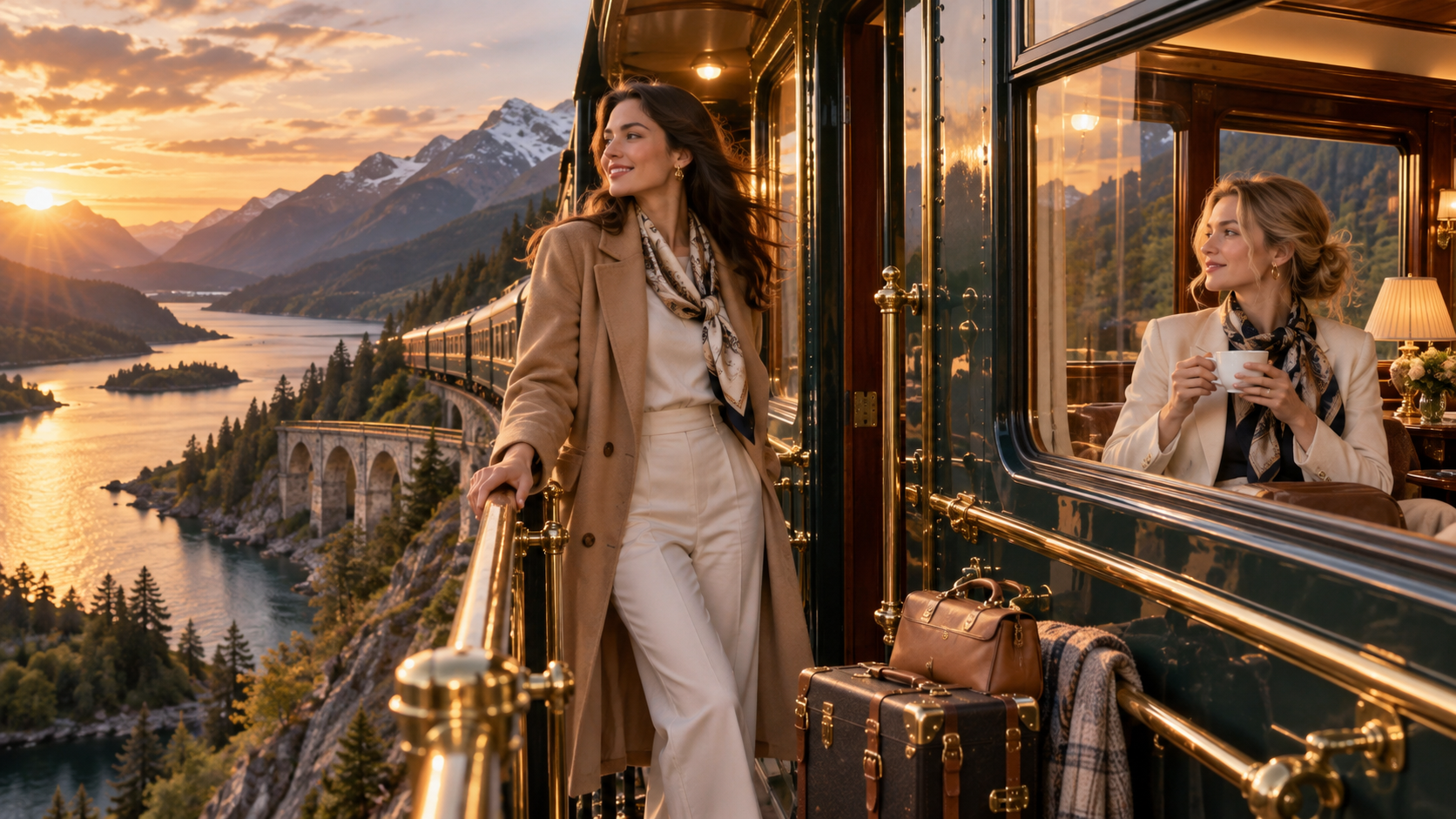

Most modern travel is designed around arriving faster.
Luxury trains work on exactly the opposite idea.
They take the distance between two places—the part airlines encourage us to sleep through—and turn it into the trip itself.
You have breakfast while mountains appear outside the window. Lunch stretches longer than expected because there is nowhere you urgently need to be. By evening, somebody has transformed the dining car for dinner while the scenery quietly changes again.
No security queue. No repacking every second night. No staring at an airport departure board wondering why your gate has changed for the third time.
The best luxury train journeys around the world are not simply expensive forms of transportation. They combine private cabins, serious dining, distinctive interiors, excursions and landscapes that are difficult to appreciate at normal travel speed.
Travel + Leisure’s updated 2026 guide reflects just how broad this category has become, spanning heritage trains in Europe, safari-style rail journeys through Africa, Japanese cruise trains, high-altitude routes in Peru and cross-country adventures in Australia. (Travel + Leisure)
Some are glamorous.
Some are adventurous.
A few manage to be both.
Here are the train journeys worth planning an entire trip around.
1. Venice Simplon-Orient-Express, Europe
There are luxury trains, and then there is the train people picture when somebody says “luxury train.”
The Venice Simplon-Orient-Express remains the reference point.
Its restored Art Deco carriages, polished wood, formal dining rooms and midnight-blue exterior lean deliberately into the golden age of European rail travel. The classic Paris-to-Venice route remains one of its signature journeys, although the network now includes several other European itineraries and longer combinations. Travel + Leisure highlights the seasonal cuisine, Art Deco interiors and bar-car ritual as central to the experience. (Travel + Leisure)
This is not casual travel.
Dinner feels like an occasion. Historic cabins preserve much of the old-world atmosphere, while newer suites and Grand Suites bring considerably more space and private facilities.
Belmond’s current schedule also shows how much the train has expanded beyond the traditional Venice journey. In 2026, special itineraries connect Paris with destinations including Florence, Portofino and the Amalfi Coast, often combining the train with stays at Belmond hotels. (Media Hub)
Best for: first-time luxury rail travelers who want the icon.
2. Seven Stars in Kyushu, Japan
Seven Stars does luxury very differently.
There is no attempt to imitate Europe.
Instead, this Japanese cruise train blends dark wood, detailed craftsmanship and restrained Japanese design with the intimacy of an extremely small hotel.
The train travels around Kyushu, Japan’s southern main island, passing mountains, coastal scenery and smaller communities along multiday routes. Travel + Leisure notes that it carries only around 20 passengers and that demand is sufficiently high for travelers to apply for journeys rather than simply choosing a departure and clicking “book.” (Travel + Leisure)
That limited capacity changes the experience.
The train feels less like mass luxury and more like being invited into a moving private club.
Meals, interiors and excursions are closely connected to Kyushu itself, which is exactly what good luxury travel should do. You never forget where you are.
And unlike some heritage trains that celebrate nostalgia, Seven Stars feels simultaneously traditional and distinctly modern.
Best for: travelers who value craftsmanship, privacy and Japanese hospitality.
3. Rovos Rail, Southern Africa
Rovos Rail is where luxury rail travel starts becoming an expedition.
The well-known Pretoria-to-Cape Town journey crosses South African landscapes ranging from the Highveld to the Great Karoo before reaching the Cape Winelands. Travel + Leisure describes the experience through its wood-paneled interiors and open-air observation balconies, where the scenery becomes as important as what is happening inside the train. (Travel + Leisure)
But the short Cape route is only the beginning.
Rovos also operates much longer journeys across southern and eastern Africa. Some itineraries combine rail with game drives, deserts, historic towns and major natural landmarks.
That makes Rovos different from a train where the principal attraction is dressing for dinner.
Yes, the interiors are elegant.
But you may also wake knowing that the day’s plan involves wildlife or a dramatic landscape rather than another European capital.
For travelers who normally find luxury travel slightly too polished, Rovos offers more texture.
There is still excellent food and a comfortable suite.
There is simply a continent unfolding beyond it.
Best for: travelers who want luxury rail mixed with safari and adventure.
4. Royal Scotsman, Scotland
The Royal Scotsman feels less like a train and more like a country house that happened to develop wheels.
Everything about it suits Scotland.
Dark wood.
Tartan.
Whisky.
Lochs appearing beyond the windows.
Clouds dropping low across the Highlands.
The train operates short multiday journeys from Edinburgh, with excursions that can include castles, countryside walks, estates and distilleries. Belmond lists itineraries ranging from two to seven nights, along with an observation car, two dining cars and an onboard Dior Spa. (Belmond)
That spa is not merely a marketing flourish.
There is something satisfyingly excessive about having a massage while the Scottish Highlands move past the window.
The train’s relatively small number of cabins also keeps the atmosphere intimate.
Evenings can feel social without turning into a large cruise environment.
And because the journeys are shorter than some of the epic rail expeditions elsewhere on this list, the Royal Scotsman works particularly well as one part of a larger UK trip.
Best for: couples, whisky lovers and anyone whose ideal luxury involves fireplaces, landscape and rain on the windows.
5. Andean Explorer, Peru
Some train journeys use scenery as decoration.
The Andean Explorer makes it the main event.
This Belmond sleeper travels high through the Peruvian Andes between Cusco, Puno and Arequipa, crossing extraordinary open landscapes and connecting travelers with Lake Titicaca.
Travel + Leisure describes it as South America’s first luxury sleeper train and notes the contrast between rugged valleys outside and distinctly Peruvian details inside—from alpaca textiles to pisco sours served in the bar and observation areas. (Travel + Leisure)
Belmond currently lists 35 sleeper cabins, full-board dining, an open-air observation car, spa carriage and guided off-train excursions. Its two-night Peruvian Highlands journey travels from Cusco to Arequipa via Lake Titicaca. (Belmond)
This is the train for people who want dramatic geography.
The altitude, broad plains and immense skies give the journey a sense of scale that is difficult to reproduce in a luxury hotel.
Just remember that the train travels through high elevations.
Planning time to acclimatize before boarding is considerably more sensible than discovering your relationship with altitude halfway through dinner.
Best for: scenery, photography and combining rail with a broader Peru itinerary.
6. Maharajas’ Express, India
India does not really need help being visually overwhelming.
The Maharajas’ Express adds polished wood, fine dining and dedicated service to the experience anyway.
Travel + Leisure points to features such as butler service for each carriage and an extremely elaborate Presidential Suite. Its longer itineraries combine rail travel with destinations such as Mumbai, Udaipur, Jaipur, Agra and Delhi. (Travel + Leisure)
The attraction is obvious.
India contains extraordinary distances and an enormous concentration of historic cities. A luxury train allows you to move between them without repeatedly checking into hotels, unpacking and rebuilding the journey.
Spend the day exploring a fort or palace.
Return to the same cabin.
Have dinner.
Wake somewhere new.
The experience naturally suits first-time visitors who want a curated introduction to Rajasthan and northern India while retaining a high degree of comfort.
That said, this is not the trip for travelers who want to disappear into local neighborhoods independently for days at a time.
It is structured.
Deliberately so.
Best for: cultural sightseeing without constant hotel changes.
7. Eastern & Oriental Express, Malaysia and Singapore
The Eastern & Oriental Express brings the grand-train idea into tropical Southeast Asia.
That changes the atmosphere immediately.
Instead of Alpine valleys or European countryside, windows frame rainforests, tropical landscapes and Malaysian scenery.
Travel + Leisure describes interiors featuring Thai silk, Malaysian embroidery and cherrywood paneling. The train also includes a Dior Spa and a culinary program influenced by Malaysian and wider Southeast Asian flavors. (Travel + Leisure)
The contrast is what makes it interesting.
Inside: polished wood and formal dinner.
Outside: dense tropical greenery.
There is also something deeply appealing about crossing a region slowly when most visitors experience Southeast Asia through short flights between major cities.
You begin noticing the landscape between destinations.
That is the entire argument for train travel, really.
Formal evening dress remains part of the experience, so this is one journey where packing only hiking clothes and a pair of sandals may lead to some awkward improvisation.
Best for: sophisticated Southeast Asian travel and food-focused couples.
8. The Ghan, Australia
The Ghan crosses Australia vertically.
That sentence alone explains much of its appeal.
Traveling between Darwin and Adelaide, the journey moves through some of the country’s most dramatic interior landscapes, with a longer expedition taking several days and incorporating off-train experiences around places such as Katherine, Alice Springs and Coober Pedy. Travel + Leisure describes the four-day journey as a luxury way to experience the Australian Outback, with onboard dining emphasizing local ingredients and Australian wines. (Travel + Leisure)
The experience is less about old-European glamour and more about scale.
The Outback can feel almost abstract when seen through a large train window.
Red earth.
Huge skies.
Long stretches where the absence of buildings becomes the landscape.
Then the train stops and you explore.
This combination makes The Ghan a strong option for people who like luxury but don’t want the journey to revolve around chandeliers and eveningwear.
It feels distinctly Australian.
As it should.
Best for: seeing the Outback without driving thousands of kilometers.
9. Transcantábrico Gran Lujo, Spain
Spain’s northern coast often gets less attention than Madrid, Barcelona and Andalusia.
That works beautifully for the Transcantábrico Gran Lujo.
The train travels between San Sebastián and Santiago de Compostela, combining northern Spanish landscapes with towns, museums, cultural visits and regional food.
Travel + Leisure notes that several of its carriages are original 1920s Pullman cars and highlights the wood-paneled interiors and panoramic viewing car. (Travel + Leisure)
This journey is particularly appealing for food-focused travelers.
Northern Spain is not exactly short of things worth eating.
Basque cuisine.
Seafood.
Cheese.
Wine.
Then Galicia waiting at the other end.
The train gives you an unusually relaxed way of linking those culinary regions without renting a car or catching repeated domestic flights.
It also avoids one weakness of some luxury trains: feeling disconnected from the destinations outside.
Here, the excursions are a major part of the journey.
Best for: food, culture and travelers who already know Spain’s major cities.
10. Golden Eagle Silk Road Express, Central and East Asia
Some luxury trains are weekend indulgences.
Golden Eagle’s longer journeys are closer to expeditions.
Its Silk Road itineraries cross landscapes tied to one of history’s great trade networks, combining cities and remote regions that would otherwise take considerable effort to connect.
Travel + Leisure describes Golden Eagle’s trains as hotel-like, with en suite cabins, dining and bar cars and extensive multiday itineraries across parts of Asia and Europe. The Silk Road Express journeys include routes through China and Tibet, moving between major cities, deserts and mountain landscapes. (Travel + Leisure)
The attraction here is the route itself.
You are not taking a luxury train simply because the upholstery is nice.
You are using it to make a complex geographical journey comfortable.
For experienced travelers who have already done the classic European train, this can feel considerably more adventurous.
Best for: long-form rail travel and travelers who care as much about geography as glamour.
Which Luxury Train Journey Should You Choose?
There is no universal winner.
If you want pure old-world glamour, choose the Venice Simplon-Orient-Express.
For wilderness and adventure, Rovos Rail makes more sense.
For craftsmanship and exclusivity, Seven Stars in Kyushu is difficult to match.
For dramatic mountain scenery, look toward the Andean Explorer.
For classic British atmosphere, take the Royal Scotsman.
For major cultural sightseeing, Maharajas’ Express is extremely efficient.
And for vast landscapes, The Ghan gives you something completely different.
This distinction matters because luxury train trips are expensive enough that choosing based only on how beautiful the cabin looks is a mistake.
The route should excite you.
The train comes second.
How Far Ahead Should You Book?
Earlier than you might expect.
These trains do not operate like giant cruise ships with thousands of cabins.
Seven Stars may carry only around 20 travelers, and Travel + Leisure specifically recommends planning well ahead because certain departures require applications or lotteries. (Travel + Leisure)
Other iconic journeys have relatively few premium suites.
If you’re traveling for an anniversary, honeymoon or specific date, start researching months in advance.
Sometimes much more.
Flexibility helps.
So does checking cabin categories carefully.
On luxury trains, the difference between entry-level accommodation and the best suite can be substantial—not merely in floor space, but in bathroom arrangements, privacy and overall comfort.
Are Luxury Train Journeys Worth the Money?
That depends on what you think you’re buying.
If you compare the fare purely with a plane ticket between the same two cities, absolutely not.
The plane will win every time.
But that’s the wrong comparison.
A luxury train is closer to combining a boutique hotel, transportation, restaurant and curated tour.
You sleep there.
Eat there.
Socialize there.
Watch the scenery there.
Then step off for experiences before returning to the same room.
The efficiency is oddly luxurious precisely because the trip feels slow.
No airport.
No new hotel.
No repacking.
You simply continue.
Why Luxury Rail Feels More Relevant Now
Travel has become astonishingly efficient.
We can cross continents faster than previous generations could cross countries.
That has obvious advantages.
It has also made the journey itself increasingly forgettable.
Luxury trains deliberately reverse that.
They make the hours between destinations important again.
That is why the best luxury train journeys around the world aren’t really about nostalgia, even when the interiors are full of polished brass and Art Deco details.
They’re about pace.
You sit.
You eat.
You look outside.
The landscape changes gradually enough that you notice.
And for once, taking longer to arrive is not a failure of the transport system.
It is what you paid for.
