


There are places you visit because of a famous monument, a museum, or a restaurant everyone keeps talking about. Then there are places where simply turning a corner feels like enough.
A crooked lane opens onto a medieval square. Wooden houses sit beside perfectly still water. Church bells carry across a mountain lake. Somewhere in the distance, a bicycle rolls over cobblestones and, for a second, the whole scene looks suspiciously well arranged.
Except nobody yelled “action.”
Some of the world’s most photogenic towns have that strange cinematic quality. Their beauty doesn’t come from enormous landmarks or futuristic skylines. It comes from scale, texture and atmosphere: old stone walls, painted shutters, fishing cabins, canals, steep roofs and streets built long before anyone worried about whether they would look good on Instagram.
A few have genuinely appeared in films. Others simply look as though a location scout should be arriving any minute.
Here are nine small towns that look like movie sets—places where reality has done a remarkably convincing job of imitating cinema.
1. Hallstatt, Austria
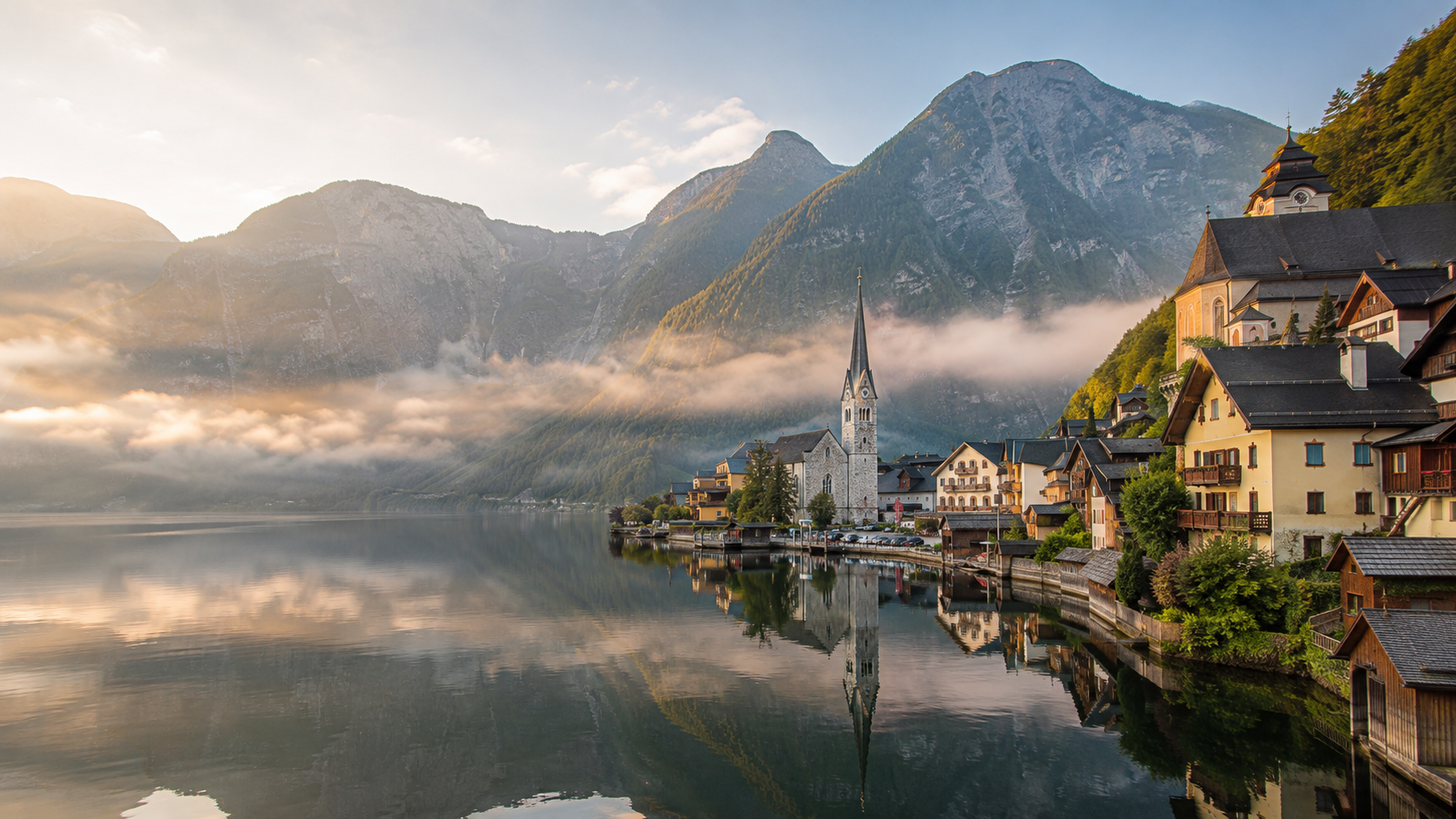
If someone designed an Alpine village specifically for the opening scene of a romantic film, it might look a lot like Hallstatt.
The village occupies an almost impossibly narrow strip of land between Lake Hallstatt and steep mountains in Austria’s Salzkammergut region. Traditional houses seem to climb the hillside above the water, while a slender church tower gives the waterfront its instantly recognizable silhouette.
The classic view is from the lake. On a quiet morning, the mountains, houses and church can all appear in the reflection, making the village seem even more carefully composed.
But Hallstatt isn’t simply a pretty backdrop. Salt has shaped the area for thousands of years, and the surrounding Hallstatt-Dachstein/Salzkammergut cultural landscape is recognized by UNESCO. Archaeological evidence shows salt extraction here stretching back to prehistoric times. (UNESCO World Heritage Centre)
That history gives Hallstatt something many photogenic destinations lack: depth. Walk away from the busiest viewpoint and you find steep stairways, weathered timber balconies, small gardens and houses pressed right against the mountain.
It looks cinematic because the setting is dramatic. It feels memorable because people have actually lived in that setting for generations.
2. Castle Combe, England
Castle Combe doesn’t have a castle dominating its skyline. It doesn’t really need one.
This tiny Wiltshire village gets its character from honey-colored Cotswold stone cottages, an old church, narrow lanes and a small bridge crossing the Bybrook. There are few visual distractions from modern life, especially in the historic center, so photographs can easily look as though they were taken several centuries ago.
And in this case, the movie-set comparison is quite literal.
Castle Combe has been used as a filming location for productions including Stardust and War Horse. Only around 50 people live in its village center, according to Visit Wiltshire, which is an important reminder that behind the picture-postcard appearance is a real community. (visitwiltshire.co.uk)
The best way to experience it is surprisingly simple: walk.
There isn’t an enormous checklist of attractions demanding your attention. Follow the main street downhill, wander toward the bridge and notice details—the uneven stone walls, wooden doors, chimneys and gardens spilling toward the lane.
It feels less like visiting an attraction and more like accidentally walking into the establishing shot of an English period drama.
3. Colmar, France
Colmar has the slightly unreasonable appearance of a town where every building decided independently to become photogenic.
Located in Alsace, near France’s border with Germany, its historic center mixes brightly colored façades, half-timbered houses, cobbled streets and flower-filled windows. Then there are the canals.
The neighborhood known as Petite Venise, or Little Venice, is particularly theatrical. Houses crowd along the waterways in shades of pink, yellow, blue and cream, while small bridges create one postcard view after another. France’s official tourism site highlights the same combination of canals, bridges, flowers and half-timbered architecture that gives Colmar its distinctive character. (FRANCE.FR)
Colmar isn’t perfectly polished, though, and that’s part of the appeal.
Look closely and buildings lean slightly. Timber beams are irregular. Alleyways suddenly narrow. A quiet street can open into a lively square filled with café tables.
That imperfection keeps the place from feeling artificial.
Early morning is when the cinematic illusion works best. Before the busiest streets fill up, shutters open, delivery bicycles appear and the canals sit almost motionless beneath the houses. It feels less like visiting a famous destination and more like arriving before the rest of the cast.
4. Rothenburg ob der Tauber, Germany
Rothenburg ob der Tauber is what happens when the phrase “medieval town” becomes a physical place.
Its old center contains towers, gates, fountains, narrow lanes, timber-framed buildings and sections of fortified walls that visitors can still walk along. Germany’s national tourism organization describes the town as having an exceptional concentration of original medieval buildings and notes that its preserved walls extend for roughly four kilometers. (Germany Travel)
Then there is Plönlein.
The little square, with a yellow half-timbered building standing between two sloping streets and old towers, has become one of Germany’s most recognizable views. Germany Travel even notes its connection to the visual inspiration for Pinocchio’s birthplace in Disney’s film. (Germany Travel)
It’s easy to understand why.
Rothenburg’s streets naturally create depth, framing and symmetry—the same things filmmakers spend considerable time trying to manufacture on a studio backlot.
Stay into the evening, though, and the town becomes more interesting. Day-trippers leave, shop doors close and the quieter lanes regain some of their older atmosphere.
Suddenly, all those towers don’t feel decorative anymore.
5. Alberobello, Italy
Most beautiful European towns share familiar ingredients: stone churches, tiled roofs, old squares.
Alberobello clearly ignored the formula.
The town in Puglia is famous for its trulli—whitewashed stone buildings topped with distinctive conical roofs. Seen individually, a trullo looks unusual. Seen in clusters, the effect is something else entirely.
More than 1,500 trulli are found across Alberobello, and the town’s remarkable collection has been recognized by UNESCO since 1996. (Italiait)
Walking through neighborhoods such as Rione Monti can feel like entering an elaborate fantasy village. Roofs rise and fall at different heights. Small lanes weave between rounded white walls. Some rooftops carry painted symbols, while flowerpots and vines add flashes of color against the limestone.
Yet these structures weren’t invented as decoration. They’re part of a long regional building tradition based on dry-stone construction.
That contrast is what makes Alberobello fascinating. It looks like a production designer became wildly creative, but its visual identity grew from practical architecture and local materials.
Real history, apparently, can be stranger than set design.
6. Shirakawa-go, Japan
Shirakawa-go changes genre with the seasons.
In summer, the village is green and pastoral, surrounded by mountains and rice fields. Autumn brings deep reds and golds. Then winter arrives, snow settles onto the steep thatched roofs, lights begin glowing through windows and the entire valley starts looking like an elaborate film miniature.
The traditional houses are built in the gassho-zukuri style, a name referring to roofs shaped like hands pressed together in prayer. Their steep pitch isn’t merely beautiful; it helps cope with the heavy snowfall experienced in this mountainous region. Some surviving homes date back centuries. (Japan Travel)
Shirakawa-go and neighboring Gokayama were added to UNESCO’s World Heritage List in 1995. Many historic houses remain part of everyday village life, while others operate as museums or accommodation. (Japan Travel)
For the full perspective, climb to the viewpoint above Ogimachi. From there, the houses sit scattered across the valley beneath forested mountains.
In winter especially, you may need to remind yourself that you’re looking at a functioning village rather than the wide establishing shot of a Japanese winter drama.
7. Giethoorn, the Netherlands
Most towns have roads outside their houses.
Giethoorn decided canals would be more interesting.
Located in the Dutch province of Overijssel, the village is known for waterways running between thatched-roof homes, gardens and small wooden bridges. Parts of the historic village are explored primarily on foot, by bicycle or on the water rather than by conventional streets.
The result is wonderfully quiet visually.
Boats move slowly beneath arched bridges. Reeds line the water. Lawns seem to run directly into canals, and traditional farmhouses appear between trees.
There is something almost suspiciously peaceful about it.
Giethoorn becomes busy during popular travel periods, so timing matters. Arrive early and you get a very different village from the one seen during the middle of a summer afternoon.
That’s true of several places on this list, actually. A beautiful town may look like a movie set, but thousands of visitors carrying phones can quickly reveal that you’re firmly back in the real world.
8. Reine, Norway
Reine doesn’t need elaborate architecture because the landscape is already doing most of the production work.
This small fishing village in Norway’s Lofoten Islands sits among water, islands and mountains that rise abruptly from the shoreline. Traditional red rorbu, or fishermen’s cabins, provide splashes of color against dark peaks and blue fjords.
Visit Norway describes Reine as a chain of islands connected by bridges and winding roads, surrounded by Vestfjord, Reinefjord and towering mountains. Fishing remains an important part of local life. (Visit Norway)
And the lighting can be absurdly good.
Summer brings the long Arctic days and the midnight sun. Winter replaces them with low, soft daylight, snow-covered peaks and, when conditions cooperate, the northern lights.
You could easily imagine a director asking for a dramatic Norwegian landscape and being told, “We don’t need CGI. Just go to Reine.”
That’s more or less the appeal. The village itself remains small and understated while nature handles the spectacle around it.
9. Piran, Slovenia
Piran looks like a piece of Venice that somehow detached itself and drifted across the Adriatic.
The old Slovenian coastal town is squeezed onto a narrow peninsula, with terracotta rooftops, closely packed houses and medieval lanes climbing from the waterfront toward St. George’s Church.
Venetian influence is visible throughout its architecture. At the center sits elegant Tartini Square, while streets branching away from it quickly become narrow, crooked and wonderfully easy to get lost in.
Slovenia’s official tourism organization describes Piran as a protected historic town shaped by salt production and Venetian influence, with tightly packed houses descending toward the coast. (I feel Slovenia)
The best view comes from above.
Climb toward the church or the old walls and Piran spreads below you: orange roofs packed against brilliant blue water, with the Adriatic stretching toward the horizon.
At sunset, the façades turn warmer, boats move across the bay and people gather around the waterfront.
Nothing particularly dramatic needs to happen.
The location has already done enough.
Why These Places Feel So Cinematic
What makes a town look like a movie set isn’t perfection.
Actually, it’s usually the opposite.
Modern cities are full of visual interruptions—traffic signs, parking structures, glass towers, utility boxes, enormous advertising screens. Historic villages often retain a more consistent visual language. Materials repeat. Buildings relate to one another. Streets were designed for people walking rather than cars moving at 60 kilometers per hour.
Then nature joins in.
Hallstatt has its lake and mountains. Reine has Arctic peaks. Piran has the Adriatic. Shirakawa-go has its snowy valley. Giethoorn has water running almost to the front doors.
The scenery isn’t sitting behind the town. It’s part of the town.
And perhaps that’s why photographs of these places can look unreal. We have become so accustomed to constructed cinematic worlds that when reality presents us with an unusually harmonious one, our first reaction is to wonder whether somebody designed it.
Visit the Town, Not Just the Photograph
There is one small problem with discovering beautiful places online: eventually everybody else discovers them too.
Hallstatt, Giethoorn, Colmar, Castle Combe and several other destinations on this list can become extremely busy. Some are tiny communities where residents still work, shop, raise families and try to get through their front doors while visitors photograph the street.
So come for the movie-set views, certainly. Just don’t treat the town like an actual movie set.
Visit early. Stay overnight when possible. Walk beyond the famous photo point. Eat somewhere local. Keep residential doorways clear. Put the camera away occasionally.
Because the most interesting moment may happen after you’ve taken the photograph.
You turn down an empty lane. Someone closes a wooden shutter upstairs. Church bells ring. A boat passes quietly beneath a bridge.
And for a few seconds, the place looks exactly like a scene from a film.
Only this time, you’re standing inside it.
