

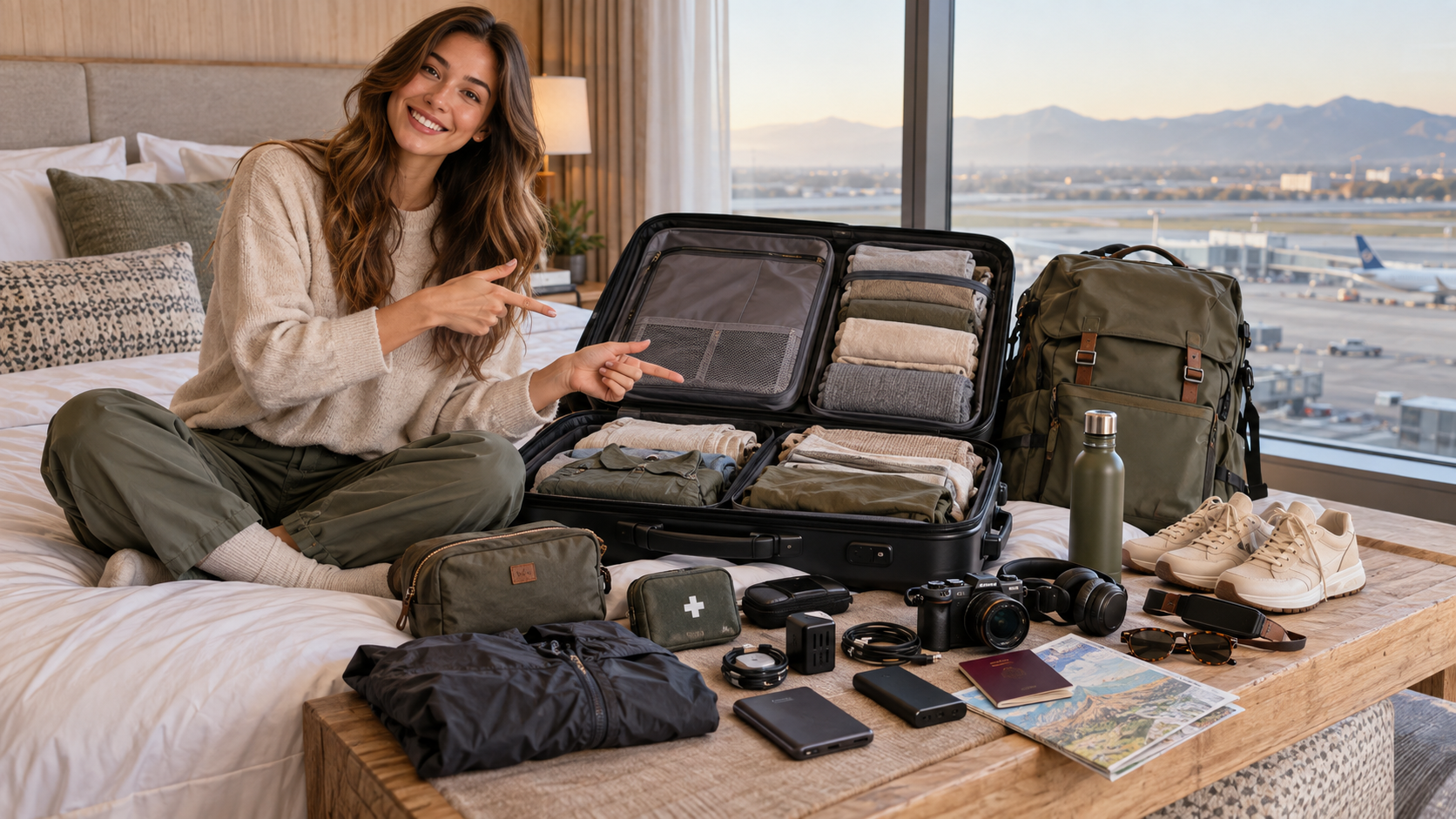

There are two kinds of travelers.
The first packs three days early, checks everything twice and somehow knows exactly which charging cable is in which pocket.
The second is kneeling on a suitcase at midnight wondering whether four pairs of shoes are really necessary for a weekend away.
Most of us move somewhere between the two.
The problem with packing is rarely a lack of stuff. It’s usually having too much of the wrong stuff and forgetting the one thing that would have made the trip easier.
That’s why a good ultimate travel gear checklist should focus less on how many things you can fit into a bag and more on what actually earns its place.
Some gear saves space. Some protects your valuables. Some keeps you comfortable during a long flight. And a few small items—an extra charging cable, a reusable bottle, a compact rain layer—can solve annoyingly large problems.
Here’s what is genuinely useful.
Start With the Right Travel Bag
Before thinking about gadgets, start with the thing carrying everything else.
For shorter trips, a good carry-on suitcase is usually enough. Look for smooth wheels, a sturdy telescopic handle and a shell or fabric body that can survive being dragged through airports without immediately looking exhausted.
Hard-shell luggage offers better structure and can protect fragile items, while soft-sided luggage often gives you a little more flexibility when packing.
Then there’s the backpack.
A travel backpack is one of the most useful pieces of gear you can own, particularly for train journeys, short flights and trips involving plenty of walking.
Ideally, it should have:
- A padded laptop compartment
- Easy-access external pockets
- Comfortable shoulder straps
- A luggage pass-through sleeve
- Enough structure that it doesn’t collapse into a pile of fabric
For day trips, don’t carry your entire travel bag around.
A lightweight foldable backpack or small crossbody bag is much easier when all you need is your phone, wallet, water and camera.
Packing Cubes Actually Help
Packing cubes sound like one of those products invented to convince organized people that they aren’t organized enough.
Then you use them.
Suddenly your clothes aren’t floating around the suitcase independently.
Use one cube for tops, one for trousers, another for underwear and perhaps a smaller one for gym or sleepwear.
The benefit isn’t only space.
It’s access.
If you’re changing hotels every few nights, you don’t want to unpack your entire suitcase just to find one T-shirt.
Compression cubes can save even more room, although it’s worth remembering that making clothes smaller does not make them lighter.
Airlines remain stubbornly interested in weight.
A Toiletry Bag That Doesn’t Leak
Everybody learns this lesson eventually.
A shampoo bottle opens inside your luggage once and you become a completely different packer.
Choose a toiletry bag with separate compartments and a wipe-clean interior. Small refillable bottles are useful for shampoo, conditioner and shower gel, particularly if you’re traveling carry-on only.
Keep liquids together rather than scattering them around your suitcase.
And pack medication separately from general toiletries.
Prescription medication should stay somewhere easy to access, ideally in your hand luggage rather than checked baggage.
A few basic health items are useful too: pain relief, plasters, antiseptic wipes and anything you already know you regularly use.
There’s no need to turn your suitcase into a pharmacy.
Just don’t assume you’ll find exactly what you want at 11:30 p.m. in an unfamiliar town.
A Reliable Power Bank
Travel has become surprisingly dependent on battery percentage.
Your phone may hold your boarding pass, hotel booking, maps, translation app, payment cards and transport tickets.
Then you use navigation for three hours and suddenly you’re at 12%.
A power bank is one of the least glamorous but most useful pieces of travel gear.
Choose one with enough capacity for at least one full phone recharge and keep it in your carry-on. Airlines generally place restrictions on lithium batteries in checked luggage, so it’s worth checking the rules for your carrier before flying.
Short charging cables help keep the setup tidy.
And yes, charge the power bank before leaving home.
Carrying an empty power bank is emotionally similar to carrying a sandwich wrapper.
Technically you brought something.
It just isn’t helping.
Universal Travel Adapter
Different countries use different plug types and voltages, so a universal adapter removes a lot of guesswork.
Look for one that covers the regions you regularly visit and includes multiple USB ports.
That way, one wall socket can charge your phone, watch, headphones and perhaps another small device without needing four separate adapters.
Be careful with high-power appliances such as hair dryers and straighteners, though.
An adapter changes the plug connection.
It doesn’t necessarily convert voltage.
Check whether your device supports the local voltage before plugging it in.
Noise-Cancelling Headphones
If you take long flights regularly, noise-cancelling headphones go from “nice to have” to “why didn’t I buy these sooner?”
Aircraft cabins are noisy even when nobody is speaking.
Reducing that constant background hum makes music, films and sleep more comfortable.
Over-ear headphones generally offer the strongest isolation, while compact noise-cancelling earbuds are easier to pack.
Whichever you choose, bring a wired option if your flight’s entertainment system requires a headphone jack.
Bluetooth is wonderful right up until the screen in front of you disagrees.
A Reusable Water Bottle
Travel days are surprisingly dehydrating.
You’re walking more, sitting in air-conditioned airports, drinking more coffee and occasionally realizing at 4 p.m. that your last glass of water was at breakfast.
A reusable bottle solves much of this.
Choose something lightweight and leak-resistant.
An insulated bottle keeps drinks cool for longer, although it usually weighs more. Collapsible bottles are useful when packing space is tight.
For air travel, take the bottle through security empty and refill it afterward where drinking water is available.
Simple.
Useful.
And much cheaper than buying bottled water repeatedly in airports.
A Small Travel Wallet or Document Organizer
You don’t need a giant folder labelled “TRAVEL DOCUMENTS.”
But keeping important items together helps.
A slim travel wallet can hold your passport, boarding pass, backup bank card, travel insurance details and any documents required for your destination.
Digital copies are useful too.
Store important booking confirmations somewhere accessible offline. If your mobile data stops working after landing, you don’t want your hotel address trapped inside an email that refuses to load.
Keep a copy of your passport separately from the original.
Hopefully you’ll never need it.
That’s rather the point.
Travel-Friendly Clothing Matters More Than Travel Gadgets
Good travel clothes aren’t necessarily clothes marketed as “travel clothing.”
They are simply pieces that work hard.
A lightweight jacket is useful on flights, cold trains and unexpectedly cool evenings.
A plain overshirt can work as a layer during the day and look decent at dinner.
Dark trousers hide minor travel mess better than pale ones.
Merino wool or similar breathable fabrics are useful because they can be worn more than once without immediately feeling unpleasant.
Shoes matter most.
For city trips, pack the pair you can walk in for hours.
Not the pair that looked excellent for eight minutes in your bedroom.
Comfortable trainers, supportive loafers or broken-in walking shoes will usually get far more use than multiple fashion-focused options.
If you need formal footwear, bring one additional pair.
Your suitcase does not need a shoe department.
A Lightweight Rain Jacket
Weather forecasts are suggestions.
A compact waterproof layer can save an entire sightseeing day.
Choose one that folds small enough to fit in your day bag. It doesn’t need to be an expedition-level shell unless you’re actually going somewhere with serious weather.
For warm destinations, prioritize breathability.
For colder trips, a waterproof outer shell can sit over your existing layers rather than requiring a separate heavy raincoat.
A tiny umbrella works too, although windy cities have a habit of turning inexpensive umbrellas into modern sculpture.
Eye Mask, Earplugs and Neck Support
People underestimate sleep gear until they need to sleep somewhere difficult.
A comfortable eye mask can help on overnight flights, trains and hotel rooms with extremely enthusiastic curtains.
Earplugs take almost no space.
And if you like neck pillows, choose one that actually supports your head rather than simply occupying half your backpack.
Some travelers love traditional U-shaped pillows. Others prefer compact wraparound or inflatable versions.
The best one is whatever allows you to arrive without feeling as though your neck has filed a formal complaint.
Portable Luggage Scale
This is particularly useful for longer trips.
A small digital luggage scale means you can check your suitcase before arriving at the airport.
That’s much better than discovering you’re several kilograms overweight while standing beside a check-in counter with six people waiting behind you.
It’s especially useful after shopping-heavy trips.
Your suitcase may have mysteriously gained weight.
The suitcase knows what happened.
Small Laundry Kit
You don’t need to pack enough clothing for every single day.
A small laundry kit can extend a compact wardrobe considerably.
Bring a travel-sized detergent or a few detergent sheets, plus a small stain-removal product.
For longer trips, a lightweight laundry bag helps separate worn clothing from clean items.
A few hotels provide laundry service, of course.
Others charge approximately the GDP of a small island to wash one shirt.
Having options is useful.
Tech Organizer
Travel cables multiply when you’re not looking.
Phone charger.
Laptop cable.
Watch charger.
Headphone cable.
Camera cable.
Then there’s the adapter and power bank.
A small tech organizer keeps all of this in one place and prevents the bottom of your backpack from turning into an electronic spaghetti bowl.
Label cables if you’re traveling with family or colleagues using similar equipment.
Nothing starts a hotel-room negotiation faster than three identical black USB-C cables and everybody insisting one of them is theirs.
Portable SSD or Cloud Backup for Photographers
If you’re taking a lot of photos or video, backups matter.
Memory cards fail.
Phones get lost.
Laptops occasionally decide that a holiday is the perfect time to develop personality issues.
For serious photography trips, carry a small SSD or upload files to cloud storage whenever internet access allows.
Don’t keep your only copy of irreplaceable travel photos on one device.
The view may have been once in a lifetime.
The memory card doesn’t care.
Small First-Aid Essentials
Again, keep this reasonable.
For normal travel, a compact kit might include:
- Adhesive plasters
- Blister pads
- Antiseptic wipes
- Basic pain relief
- Any personal medication
- Motion-sickness medication if you use it
- Rehydration salts where appropriate
For remote hiking or adventure travel, the list becomes more specific.
But for a normal city break, you don’t need equipment for performing field surgery.
A blister plaster may be the single most useful item after day one of walking.
Sunscreen and Sunglasses
These belong on almost every travel list, not just beach trips.
City walking can mean several hours outdoors.
Mountain destinations often expose you to strong sunlight.
Even winter trips can involve significant UV exposure.
Pack sunscreen somewhere accessible rather than beneath seven layers of clothing in your suitcase.
Sunglasses should be comfortable enough to wear all day.
The stylish pair that constantly slides down your nose may not survive the trip emotionally.
Security Gear: Keep It Simple
You don’t need to travel as though every destination is a crime thriller.
A few sensible measures are enough.
Use luggage locks where appropriate. Keep your passport and primary bank card somewhere secure. Carry a backup payment method separately.
A crossbody bag with a secure zip can be useful in crowded areas.
Some travelers like tracking devices inside luggage, particularly checked bags.
That’s reasonable.
The important thing is not becoming so obsessed with theft prevention that you spend the entire trip suspiciously clutching your backpack.
Awareness works better than paranoia.
What You Probably Don’t Need
Travel gear marketing can become impressive.
Suddenly you need a special towel, special cutlery, five mini containers, a portable steamer, door alarms, shoe bags, ten kinds of organizers and a pillow that looks like equipment from a space program.
Some of these things are useful in specific situations.
Most aren’t necessary for every trip.
Before packing anything, ask one question:
Will I realistically use this more than once?
If the answer is probably not, leave it.
Travel becomes easier when you’re not managing too many possessions.
The Ultimate Travel Gear Checklist
For most trips, a practical setup looks something like this:
- Carry-on suitcase or travel backpack
- Day bag or crossbody
- Packing cubes
- Toiletry bag
- Prescription medication and basic first aid
- Passport and travel wallet
- Copies of important documents
- Power bank
- Universal adapter
- Charging cables
- Noise-cancelling headphones or earbuds
- Reusable water bottle
- Comfortable walking shoes
- Lightweight jacket
- Compact rain layer
- Sunglasses and sunscreen
- Eye mask and earplugs
- Laundry bag and small detergent
- Tech organizer
- Luggage scale for longer trips
- Camera gear if needed
- Backup storage for important photos
- Secure backup payment card
- Luggage tracker if useful
That’s enough for most travelers.
The destination will decide the rest.
Pack for the Trip You’re Actually Taking
This is where people get into trouble.
A week in Tokyo does not need the same gear as ten days trekking in Nepal.
A beach holiday in Thailand doesn’t require the same footwear as a winter city break in Prague.
Start with the trip.
Then build the gear around it.
Not the other way around.
The best ultimate travel gear checklist isn’t the longest one. It’s the one that removes small annoyances without creating new ones.
Your suitcase should contain things that make the journey easier, more comfortable or safer.
Everything else is just weight.
And if you arrive at the airport with one pair of shoes fewer than you originally planned?
You’ll probably survive.
You may even have room for something on the way home.
