

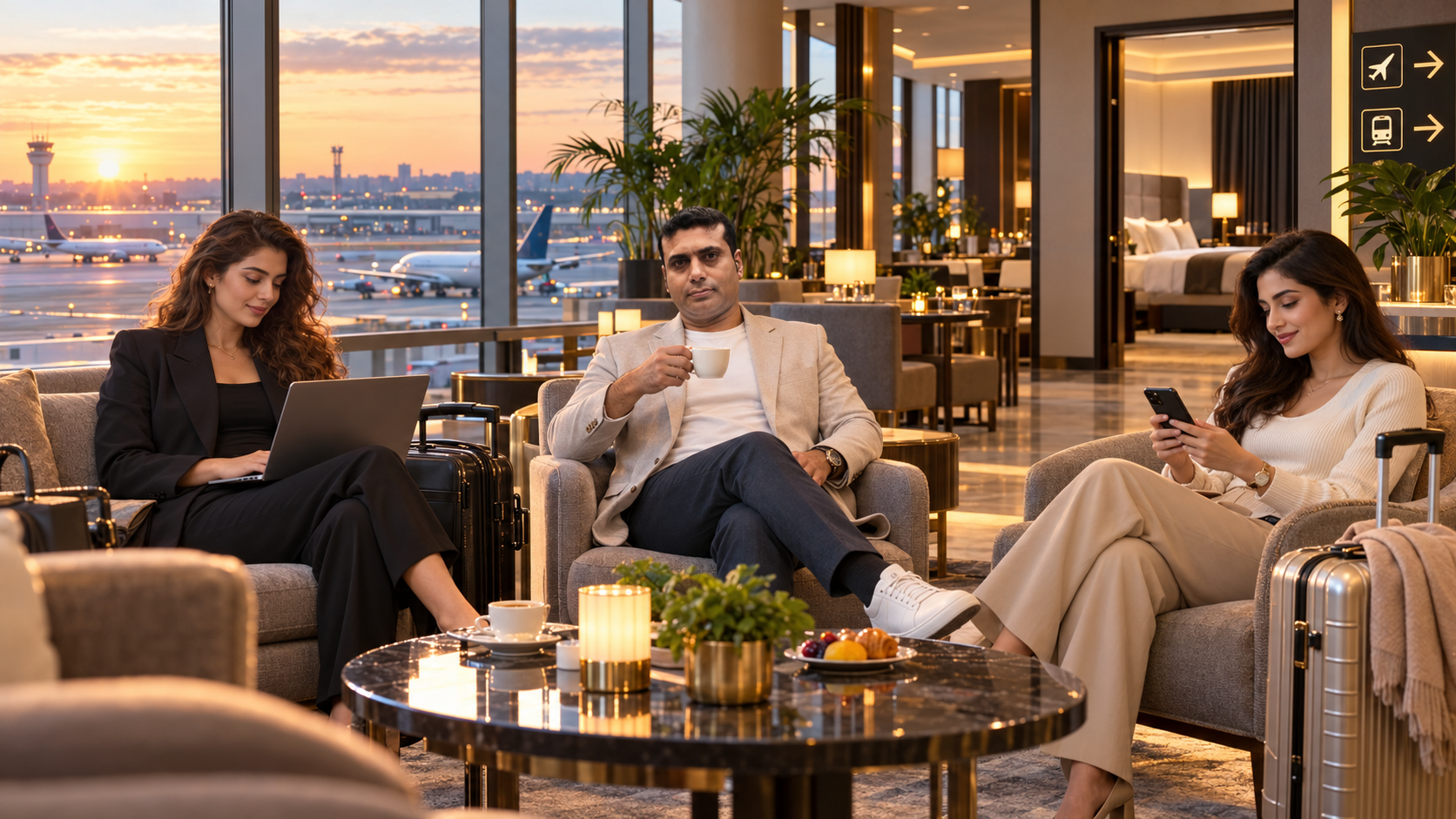

Airport hotels used to ask very little of themselves.
A bed. Beige carpet. An alarm clock. A shuttle bus that appeared approximately when it felt like appearing.
Nobody expected romance.
You booked one because your flight landed at midnight, left at 6 a.m., or had been canceled while you were already arguing with an airline app.
That category has changed.
Some of today’s best airport hotels have serious restaurants, attractive bars, gyms, pools, runway views, thoughtful architecture and rooms comfortable enough that staying near the terminal no longer feels like surrendering a night of your trip.
Condé Nast Traveler’s airport-hotel editors make the distinction neatly: location, convenience and practicality remain essential, but travelers no longer have to give up design and style to get them. Its editor favorites include properties such as New York’s TWA Hotel, Grand Hyatt at San Francisco International Airport and Hilton Amsterdam Airport Schiphol precisely because they solve the airport problem while still feeling like proper hotels. Condé Nast Traveler
So what are the best airport hotel features worth looking for?
The answer starts before the room.
The Best Airport Hotel Features at a Glance
| Feature | Why It Matters | Priority |
|---|---|---|
| Direct terminal connection | Removes transfer stress entirely | Essential |
| Reliable shuttle or airport train | Makes off-terminal hotels practical | Essential |
| Strong sound insulation | Lets you actually sleep near aircraft | Essential |
| Blackout curtains | Critical for jet lag and daytime sleep | Essential |
| Flexible check-in/check-out | Useful for unusual flight times | Very high |
| 24-hour reception | Necessary for delayed arrivals | Very high |
| Early breakfast / late dining | Fits airline schedules | High |
| Excellent shower | More valuable after long-haul travel than another decorative pillow | High |
| Comfortable bed | The entire point of the booking | Essential |
| Runway views | Turns proximity into an experience | Nice bonus |
| Gym or pool | Valuable on long layovers | Trip dependent |
| Workspace + strong Wi-Fi | Important for business travelers | High |
| Luggage storage | Useful before/after flight windows | High |
| Day-use rates | Excellent for long daytime connections | Very useful |
The mistake is assuming the hotel with the longest amenity list is automatically best.
For an airport stay, friction matters more than luxury.
1. Direct Terminal Access Is the Feature Worth Paying For
An airport hotel can describe itself as “minutes from the terminal” and still require:
a shuttle reservation, luggage loading, traffic, another unloading process and the small existential crisis of wondering whether the bus is ever coming.
Direct terminal access changes the entire stay.
Condé Nast Traveler’s editors praise the Hilton Amsterdam Airport Schiphol partly because guests can walk to it without leaving the airport complex, while the Grand Hyatt SFO has its own AirTrain stop; CNT’s reviewer reported reaching the terminal in no more than about ten minutes. Condé Nast Traveler
Travel + Leisure highlighted the same Grand Hyatt in July 2026, specifically calling out its runway-view rooms and AirTrain connection as reasons it works so well as an airport hotel. Travel + Leisure
That convenience is particularly valuable if you:
have an early departure, arrive late at night, travel with children, carry several bags or are connecting in winter weather.
If two hotels cost almost the same and one lets you walk directly into the terminal, I would usually choose it.
Airport stays are not the time to add unnecessary transportation.
2. Check Which Terminal It Is Actually Connected To
“Connected to the airport” sounds definitive.
It isn’t always.
Huge airports can operate like small cities.
A hotel may connect beautifully to Terminal 2 while your flight leaves from Terminal 5, involving another train, security procedure or long walk.
Before booking, look at the exact route from:
hotel room ? airline check-in counter or departure terminal.
Not merely:
hotel ? airport.
This matters particularly at major international hubs.
The useful number isn’t distance in kilometers.
It’s door-to-terminal time with luggage at 5:30 in the morning.
That tends to produce a more honest answer.
3. Soundproofing Matters More Than the Lobby
There is something wonderfully ironic about checking into an airport hotel and then being unable to sleep because airplanes are nearby.
A beautiful lobby will not help.
Neither will marble in the bathroom.
Strong sound insulation should be near the top of your shortlist.
Unfortunately, hotels rarely publish useful technical information about it.
That is where recent reviews help.
Search specifically for:
aircraft noise, runway noise, hallway noise, soundproof, quiet room, sleep.
Do not automatically reject runway-facing rooms. Well-designed airport hotels can provide dramatic aircraft views while keeping the interior remarkably quiet.
The goal is not to pretend the airport isn’t there.
It is to decide when you hear it.
4. Blackout Curtains Are Not a Minor Detail
Airport stays operate on unusual clocks.
You may arrive from Asia at 8 a.m. and desperately want to sleep at noon.
Or you may need to be asleep by 7 p.m. before a very early departure.
Ordinary hotel assumptions about “night” do not work particularly well here.
Proper blackout curtains are therefore one of the most valuable airport-hotel features.
Check guest reviews.
Photos sometimes reveal whether curtains cover the entire window or leave a bright little strip of daylight precisely at eye level.
Also look at whether the room has:
quiet climate control, bedside charging, multiple lighting settings and simple controls.
A jet-lagged traveler should not need an engineering qualification to turn off the lamps.
5. The Shower Matters Almost as Much as the Bed
After a long-haul flight, the most luxurious hotel feature may be hot water with decent pressure.
This becomes even more important during layovers.
You might have six or eight hours between flights—too long to sit comfortably at the airport, but too short to treat the hotel as a conventional overnight stay.
A good airport room should let you:
shower, change clothes, sleep briefly and leave feeling human again.
That is also why spacious bathrooms, strong hair dryers, robes and useful toiletries carry more weight here than they might at an ordinary city hotel.
A bathtub can be pleasant.
A powerful shower that takes thirty seconds to understand is better.
6. Flexible Check-In Is a Serious Competitive Advantage
Flights do not care about hotel convention.
Arriving at 7 a.m. and being told your room will be ready at 3 p.m. defeats much of the purpose of booking an airport hotel.
When researching, look for:
early check-in, late check-out, day-use bookings, half-day rooms or hourly blocks.
Some airport properties are specifically designed around transit schedules rather than traditional hotel nights.
Condé Nast Traveler’s 2026 airport coverage notes that Doha’s Oryx Airport Hotel, located inside Hamad International Airport, offers shorter-duration options for travelers on longer layovers—exactly the kind of flexibility that makes an airport hotel genuinely useful rather than merely nearby. Condé Nast Traveler
Even when flexible hours are not advertised, contact the property.
A guaranteed early room may be worth paying for.
7. 24-Hour Reception Should Be Standard—but Verify It
International flights arrive at inconvenient times.
Delays make them more inconvenient.
An airport hotel that effectively closes down after midnight has misunderstood its clientele.
Check whether reception is staffed 24 hours and whether late arrival is genuinely straightforward.
If your flight is scheduled to land at 11:45 p.m., remember:
landing is not arrival at the hotel.
Immigration, baggage reclaim, terminal transfers and delays can easily push check-in into the early morning.
The last thing you want at 2 a.m. is a locked door and a phone number taped beside it.
8. Food Should Follow Flight Schedules, Not Restaurant Schedules
The breakfast buffet may be excellent.
Less useful if it opens at 7 a.m. and your flight boards at 6:20.
Look for:
very early breakfast, grab-and-go options, 24-hour room service, late-night dining, lobby food or nearby terminal restaurants.
Condé Nast Traveler’s favorite airport hotels stand out partly because they behave like full-service properties rather than sleeping facilities; the TWA Hotel, for example, combines its aviation-themed design with multiple restaurants and public spaces, while Grand Hyatt SFO includes dining overlooking the runway. Condé Nast Traveler
Even a small practical option helps.
Coffee.
Fruit.
Sandwiches.
Something that does not require you to begin travel day hungry because the hotel’s kitchen follows normal human hours.
9. A Good Airport Hotel Should Have Somewhere You Actually Want to Sit
This is one of the main differences between an airport hotel and an airport hotel that doesn’t feel like one.
The bad version makes you want to go directly from lobby to bedroom.
The good version gives you somewhere to decompress.
A comfortable bar.
An attractive restaurant.
A proper lounge.
A courtyard.
A runway-view seating area.
Somewhere you can have a drink or meal and briefly forget that your suitcase contains four charging cables and no clean socks.
Condé Nast Traveler’s editors specifically value design and sense of place alongside location and practicality when assessing standout airport hotels. Condé Nast Traveler
That is a useful booking philosophy.
You only need the room to sleep.
But if you have six awake hours, public spaces start to matter.
10. Runway Views Can Turn the Airport Into the Attraction
Runway-view rooms sound like something only aviation enthusiasts would care about.
They are more entertaining than expected.
Planes taxiing in the distance give an otherwise generic hotel view movement and context.
Grand Hyatt SFO is a good example: both Travel + Leisure and Condé Nast Traveler highlight its airport views and close integration with the terminal experience. Travel + Leisure
Just make sure point three—sound insulation—has been solved first.
There is a difference between:
watching a plane land
and
participating acoustically in every landing all night.
11. Fitness Facilities Are More Useful Than They Sound
After twelve hours sitting on an airplane, a treadmill suddenly becomes compelling.
A decent gym is particularly useful for:
business travelers, long layovers and people adjusting to a new time zone.
A pool can be even better if you have several hours to fill.
But opening times matter.
A hotel gym opening at 9 a.m. is not especially helpful to guests departing at dawn.
Check the actual schedule rather than assuming “fitness center” means 24 hours.
This is a recurring lesson with airport hotels:
the feature is only useful if its operating hours understand aviation.
12. Great Wi-Fi and a Real Desk Matter for Business Travel
Business travelers frequently use airport hotels as temporary offices.
A missed connection can suddenly create three hours of work time.
A morning meeting may happen before the next flight.
So look beyond “free Wi-Fi.”
You want:
stable internet, desk space, accessible outlets, USB/USB-C charging, comfortable seating and decent lighting.
If the hotel advertises meeting rooms or business facilities, that’s useful—but a room where you can actually open a laptop without balancing it on your suitcase may be enough.
Also check mobile signal in recent reviews.
Concrete-heavy airport architecture can produce surprises.
13. Luggage Storage Can Save an Entire Day
Suppose your flight leaves at 10 p.m.
Checkout is noon.
Without storage, your luggage becomes your travel companion for ten hours.
Good airport hotels should make it easy to leave bags before check-in or after checkout.
This becomes especially useful when the airport has fast city connections.
Stay overnight, leave the bags, spend the day exploring, return for luggage, then head to the terminal.
The hotel stops being merely somewhere to sleep.
It becomes a logistics base.
14. “Near the Airport” Is Not the Same as an Airport Hotel
This distinction causes bad bookings.
A property may advertise itself as an airport hotel while sitting fifteen minutes away by car.
That can be perfectly fine.
But investigate the shuttle.
Ask:
Is it complimentary?
How often does it run?
Is it 24 hours?
Do you need to call on arrival?
Where exactly does it collect passengers?
Does it serve every terminal?
Condé Nast Traveler praises Manila Marriott’s dependable terminal shuttle because Manila traffic can make independent transfers frustrating; in that setting, reliable hotel transport becomes part of the product rather than a small extra. Condé Nast Traveler
A cheap room with an unreliable transfer can become expensive very quickly if you miss a flight.
15. Look for Some Sense of Place
Airport hotels have traditionally been designed as if nobody should know what country they are in.
That no longer needs to be the case.
Architecture, local food, artwork, views and interior design can give the stay some personality.
New York’s TWA Hotel is the obvious extreme: it incorporates Eero Saarinen’s historic TWA Flight Center and turns aviation heritage into the entire experience. Condé Nast Traveler describes it as much more than a convenient JFK overnight—the design itself is a reason to visit. Condé Nast Traveler
Your airport hotel does not need a museum.
But it should ideally feel like somewhere.
Not merely nowhere beside Gate B27.
A Simple Airport Hotel Scorecard
Before booking, score each property from 1 to 5 on:
Terminal convenience
Sleep quality
Arrival/departure flexibility
Food availability
Shower/bathroom quality
Wi-Fi/work setup
Public spaces
Value
Double the score for the first two.
That keeps priorities straight.
A magnificent rooftop pool does not compensate for a 35-minute shuttle ride at 4:45 a.m.
When Is an Airport Hotel Actually Worth It?
I would strongly consider one when:
your flight leaves before roughly 8 a.m., you arrive very late, the airport is far from the city, you have an overnight connection, public transport stops at night or weather could make the morning journey unreliable.
It may also be worth booking after a long international arrival rather than forcing yourself into another train, taxi or domestic connection while exhausted.
Airport hotels are essentially insurance against travel-day friction.
The value is often less about the room and more about what does not happen:
no predawn taxi anxiety.
No highway traffic.
No wondering whether the train has started running.
No dragging luggage through a city for six sleeping hours.
That can be worth more than a nicer hotel downtown.
The Best Airport Hotels Solve Stress Before They Add Luxury
The airport hotel has finally escaped its reputation as travel’s waiting room.
The good ones understand that convenience alone is not enough anymore.
You still need the practical things:
terminal access, reliable transfers, quiet rooms, blackout curtains, flexible timing and food when actual travelers need it.
But once those fundamentals are solved, design begins to matter.
So does a good bar.
A satisfying shower.
A runway view.
A room you don’t immediately want to leave.
When comparing the best airport hotel features, start with one question:
Will this property make tomorrow’s flight materially easier?
Then ask whether you will actually enjoy the hours before it.
If the answer to both is yes, you have found the modern version of an airport hotel.
And with any luck, it will be the only part of your connection that feels as though it was designed around a human being.
