

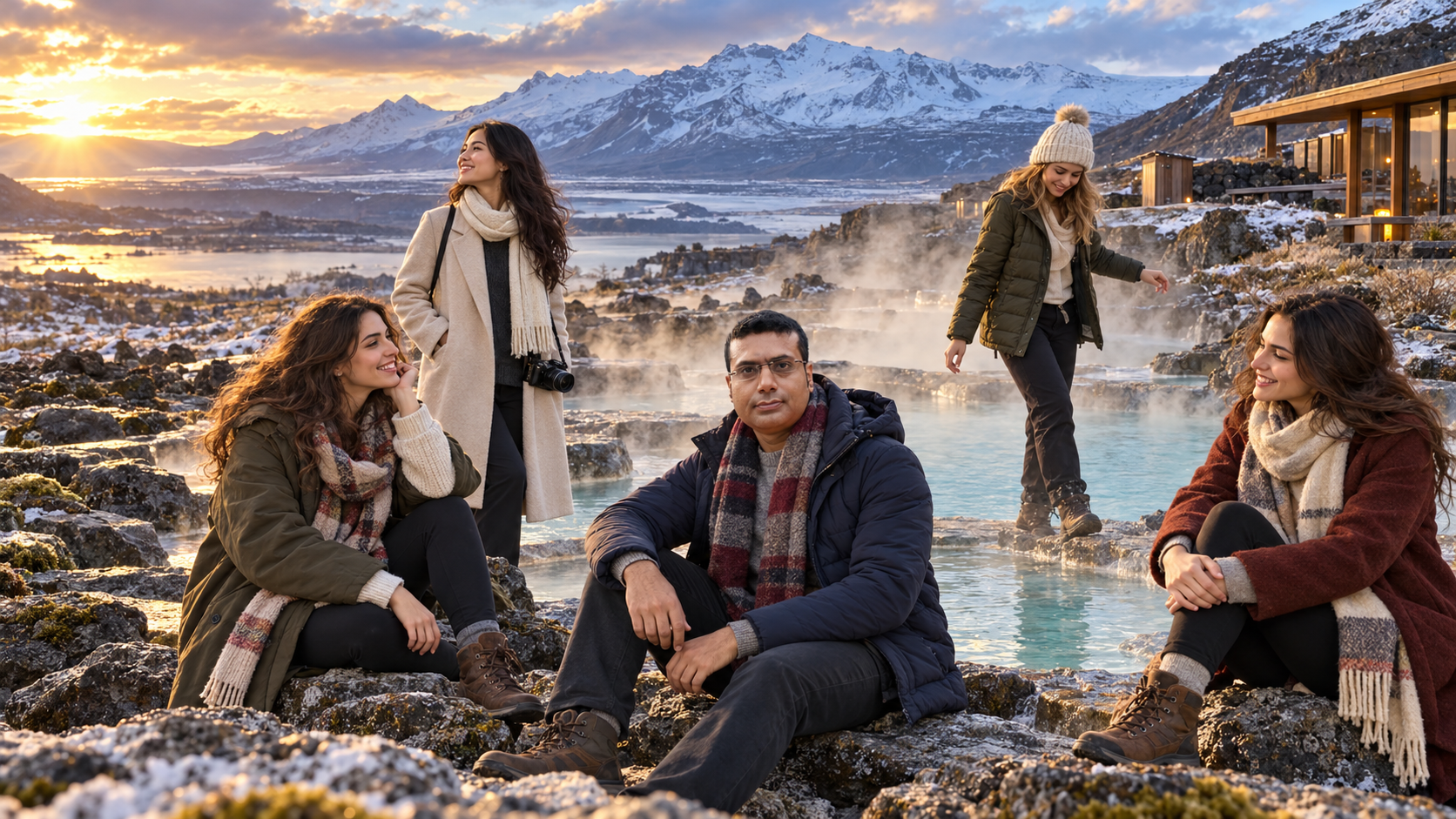

Suggested Alt Text:
There is a particular kind of happiness that happens when the air is cold, the landscape is enormous, and everything below your shoulders is submerged in hot water.
Hot springs turn otherwise ordinary travel days into memories.
You might hike through a Japanese mountain town in a yukata before slipping into an outdoor bath beside a river. In Iceland, you can float through milky geothermal water surrounded by black volcanic rock. In Tuscany, naturally heated water runs over pale stone terraces in the middle of the countryside.
And sometimes the journey is half the point.
Some of the best hot springs in the world require mountain hikes, boat rides or winter drives. Others have been transformed into sophisticated wellness resorts where geothermal water comes with robes, saunas and excellent restaurants.
The right one depends on whether you want wilderness, culture, luxury or simply somewhere extraordinary to sit still for an hour.
The Best Hot Springs in the World at a Glance
| Destination | Country | Best For | Ideal Time |
|---|---|---|---|
| Kurokawa Onsen | Japan | Traditional onsen culture | Oct–Apr |
| Blue Lagoon & Icelandic geothermal circuit | Iceland | First-time geothermal trip | Year-round |
| Pamukkale | Turkey | Scenery + ancient history | Apr–May, Sep–Oct |
| Terme di Saturnia | Italy | Romantic countryside trip | Spring & fall |
| Rotorua | New Zealand | Geothermal landscapes + culture | Mar–Oct |
| Chena Hot Springs | Alaska, USA | Hot springs + northern lights | Sep–Mar |
| Termas Geométricas | Chile | Architecture + wilderness | Dec–Mar |
| Banjar Hot Springs | Bali, Indonesia | Tropical hot spring escape | Apr–Oct |
| Hot Springs Cove | Canada | Remote nature experience | May–Sep |
| Dunton Hot Springs | Colorado, USA | Luxury mountain retreat | Year-round |
One thing before planning: not every spectacular geothermal pool is safe for bathing. Places such as Yellowstone’s Grand Prismatic Spring and New Zealand’s Champagne Pool are magnificent to look at but far too hot to enter. Condé Nast Traveler includes both among the world’s notable geothermal landscapes while explicitly noting that swimming is prohibited. Condé Nast Traveler
For this list, I’ve prioritized places where the bathing experience itself can be an important part of the trip.
1. Kurokawa Onsen, Japan — Best Overall Cultural Experience
Japan does hot springs differently.
An onsen visit is not simply a spa appointment inserted between sightseeing stops. In the right town, it becomes the trip.
Kurokawa Onsen on Kyushu is one of the strongest examples. Traditional ryokan inns, wooden bridges, forested hills and outdoor baths are concentrated into a compact mountain settlement where moving from bath to bath feels almost ceremonial.
Japan’s tourism authority explains that onsen are naturally geothermally heated and vary significantly in mineral composition from one region to another. Traditional bathing usually involves washing thoroughly before entering, keeping towels out of the bath and bathing without swimwear; tattoo policies can still vary by property. Japan Travel Guide
For a first trip, stay overnight rather than visiting for a few hours.
Choose a ryokan with dinner and breakfast included, take your time, and treat the bath as part of the evening rather than something to check off.
Best for: Couples, slow travelers, food lovers and anyone wanting the hot spring to feel culturally meaningful.
ArticleSet pick: If I could choose only one destination from this list for the complete experience rather than simply the most dramatic photograph, I would choose Kurokawa.
2. Iceland — Best for Geothermal Road Trips
It is difficult to separate hot springs from Iceland itself.
Geothermal bathing is woven into local life, and travelers can now choose everything from rustic countryside pools to extremely polished lagoon experiences.
The Blue Lagoon remains the internationally famous option: mineral-rich geothermal seawater sits among dark lava fields, with temperatures typically around 37–40°C. Visit Iceland also highlights a much wider geothermal circuit, including Sky Lagoon, Krauma, Secret Lagoon and several newer or recently expanded facilities around the country. Visit Iceland
That variety is why I would approach Iceland differently from most destinations on this list.
Don’t travel there for one hot spring.
Build geothermal bathing into the road trip.
A winter itinerary might combine a city stay in Reykjavík, a sophisticated lagoon experience and a smaller countryside pool after a day outside.
There is one important 2026 consideration. The Reykjanes Peninsula has experienced repeated volcanic activity since 2021. Blue Lagoon’s September 2026 update said no eruption was underway at that time and described monitoring, evacuation procedures and protective barriers, but conditions in the region can change. Check current official information before traveling. Blue Lagoon Iceland
Best for: First-time hot-spring travelers, couples, winter trips and people who want strong infrastructure without losing dramatic landscapes.
3. Pamukkale, Turkey — Best Combination of Hot Springs and History
Some geothermal destinations feel beautiful.
Pamukkale looks impossible.
Mineral-rich water has created brilliant white travertine terraces above the ruins of Hierapolis, forming one of Turkey’s most recognizable landscapes.
Condé Nast Traveler describes the site as a series of tiered thermal pools associated with the ancient spa city of Hierapolis, together recognized as a UNESCO World Heritage destination. Condé Nast Traveler
The advantage of Pamukkale is that you aren’t traveling across the world solely to soak.
You are combining:
thermal landscapes,
archaeology,
ancient Roman history,
and one of Turkey’s most distinctive natural formations.
Go early or later in the day if your schedule permits. Midday crowds can change the atmosphere completely.
And manage your expectations: this is a major tourist destination rather than an undiscovered wilderness pool.
Best for: Travelers who want their hot spring trip mixed with archaeology and sightseeing.
4. Terme di Saturnia, Tuscany — Best Romantic Hot-Spring Escape
Tuscany hardly needed another advantage.
Yet southern Tuscany has naturally heated spring water cascading over travertine formations at Saturnia.
The famous Cascate del Mulino creates a series of informal natural pools in the countryside, while a more developed resort experience is available nearby. Condé Nast Traveler notes that the water remains around 99°F, making the destination suitable for long, relaxed bathing rather than a quick plunge. Condé Nast Traveler
This is one of my favorite destinations to combine with a road trip.
Don’t fly to Italy, rush to Saturnia, take the photograph and leave.
Rent a car.
Stay in the countryside.
Eat dinner somewhere tiny.
Visit hill towns.
Then arrive at the springs when the light is softer and the trip no longer feels like an attraction itinerary.
Best for: Couples, Tuscany road trips and travelers who want natural springs without sacrificing good food and beautiful accommodation.
5. Rotorua, New Zealand — Best for a Full Geothermal Landscape
Rotorua is not a single spring.
That is precisely why it belongs here.
The region is filled with geothermal activity: steam vents, mud pools, mineral baths and sulfur-rich landscapes. New Zealand’s official tourism organization also emphasizes the region’s M?ori history and the relationship between local culture and thermal bathing traditions. New Zealand
This makes Rotorua better for travelers who want to understand geothermal landscapes, not merely sit in one.
Spend a few days.
Visit active geothermal areas.
Book a proper soak.
Make time for M?ori cultural experiences rather than treating the destination as a collection of natural attractions.
One caution: some of Rotorua’s most visually extraordinary geothermal pools are viewing attractions rather than swimming holes.
The water sometimes knows exactly how beautiful it is and still refuses to let you in.
Best for: Families, road-trippers, nature lovers and travelers interested in geothermal science and M?ori culture.
6. Chena Hot Springs, Alaska — Best for a Winter Adventure
There is a simple reason Chena works so well:
hot water feels better when the world around you is freezing.
Located roughly 60 miles from Fairbanks, Chena Hot Springs pairs geothermal bathing with one of Alaska’s strongest winter attractions—the possibility of seeing the aurora.
Condé Nast Traveler describes an outdoor hot-spring setting plus indoor and outdoor bathing facilities, with the springs forming the heart of the surrounding resort. Condé Nast Traveler
A northern-lights sighting is never guaranteed.
That is important.
But this is precisely the sort of destination where the trip still works even if the sky refuses to cooperate.
Spend the day outside.
Warm up.
Eat.
Soak.
Try again tomorrow.
Best for: Winter travelers, couples and anyone already planning a Fairbanks northern-lights trip.
7. Termas Geométricas, Chile — Best for Design Lovers
Deep within southern Chile’s green landscape, Termas Geométricas takes a completely different approach.
Hot spring water is only half the story.
Architect Germán del Sol created a striking sequence of pools connected by bold red wooden walkways surrounded by dense vegetation and waterfalls. Condé Nast Traveler reports 17 naturally fed pools with different temperatures. Condé Nast Traveler
The design doesn’t compete with the landscape.
It organizes your movement through it.
That makes this one of the world’s strongest examples of architecture improving a natural bathing experience rather than overwhelming it.
Combine it with Chile’s Lake District, Pucón and outdoor activities around Villarrica.
Best for: Architecture enthusiasts, couples and travelers already exploring Chilean Patagonia or the Lake District.
8. Banjar Hot Springs, Bali — Best Tropical Option
Most people don’t associate Bali with hot springs.
They think beaches, villas, temples and rice fields.
Banjar provides a useful reason to travel north.
The springs sit in a lush tropical setting, with warm mineral water flowing through carved spouts into bathing pools. Condé Nast Traveler places Banjar near the Buddhist monastery Brahma Vihara Arama, making it easy to combine the springs with a wider northern Bali itinerary. Condé Nast Traveler
This is not the polished infinity-pool Bali you see constantly online.
That is part of the appeal.
North Bali generally rewards travelers willing to move beyond the island’s busier southern areas.
Best for: Southeast Asia itineraries, couples and travelers looking for something beyond Bali’s beach-club circuit.
9. Hot Springs Cove, Vancouver Island — Best Remote Nature Soak
Some hot springs make things easy.
Hot Springs Cove makes you earn them.
Located in Maquinna Marine Provincial Park off Vancouver Island, the site is reached by boat or floatplane, followed by the approach through coastal wilderness.
Condé Nast Traveler describes naturally heated water cascading toward rocky pools near the ocean, with different temperatures depending on your position relative to the hot-water source and colder seawater. Condé Nast Traveler
The access is part of what makes this one memorable.
You may travel through spectacular coastal scenery before you even reach the springs.
This isn’t where I would go for spa robes and cucumber water.
That’s the point.
Best for: Adventure travelers, wildlife lovers and people visiting Vancouver Island or Tofino.
10. Dunton Hot Springs, Colorado — Best Luxury Hot-Spring Retreat
At the opposite end of the spectrum sits Dunton.
This restored Colorado mountain settlement combines hot springs with cabins, high-end food and an intentionally secluded atmosphere.
Condé Nast Traveler describes several ways to experience its thermal water, including indoor and outdoor pools and a restored 19th-century bathhouse. Condé Nast Traveler
The reason to choose Dunton is not value.
It is immersion.
You can essentially make the springs, mountains and resort the entire trip.
In winter, snow changes the character completely. In warmer months, the surrounding San Juan Mountains become the reason to leave the water occasionally.
Best for: Honeymoons, anniversaries, luxury travelers and people who want isolation without roughing it.
Which Hot-Spring Destination Should You Choose?
Here’s my simpler decision framework.
If you want culture, choose Kurokawa Onsen.
If you want dramatic landscapes with excellent tourism infrastructure, choose Iceland.
If you want history, choose Pamukkale.
If you want romance, choose Saturnia.
If you want geothermal exploration, choose Rotorua.
If you want winter + aurora potential, choose Chena.
If you want architecture, choose Termas Geométricas.
If you want tropical relaxation, choose Banjar.
If you want adventure, choose Hot Springs Cove.
If you want luxury, choose Dunton.
That is more useful than trying to declare one pool objectively better than every other pool on Earth.
The Mistakes That Can Ruin a Hot-Spring Trip
The first mistake is assuming every hot spring works like a swimming pool.
It doesn’t.
In Japan, for example, traditional onsen etiquette generally requires guests to wash before entering and keep towels out of the water. Public baths commonly require nudity, although private baths can be an alternative for travelers uncomfortable with that setup or concerned about tattoo restrictions. Japan Travel Guide
The second mistake is assuming beautiful geothermal water is safe.
Never enter an unapproved geothermal pool merely because somebody on social media did.
Temperatures can change. Ground can be unstable. Some waters contain dangerous chemistry.
Use designated bathing areas.
The third mistake is rushing.
A geothermal destination is one of the few places where doing less usually improves the experience.
Don’t schedule your soak between six other attractions.
Arrive.
Shower.
Put the phone away.
Stay until you stop checking the time.
Best Time of Year for a Hot-Spring Trip
Hot springs work year-round, but contrast creates magic.
Cool air + warm water is usually better than hot air + hot water.
That is why autumn, winter and early spring work especially well in Japan, Iceland, Alaska, Colorado and much of Europe.
Tropical destinations such as Bali are different. Morning or later-afternoon visits can feel more comfortable than soaking through the hottest part of the day.
In remote locations, however, road and boat accessibility may matter more than temperature.
The “best” month is therefore not always the coldest.
It is the month when you can reliably reach the water.
Are the World’s Best Hot Springs Worth Traveling For?
Yes—but usually not because of the minerals.
The strongest hot-spring destinations combine warm water with something you could not reproduce in a hotel spa.
A Japanese ryokan.
An Icelandic lava field.
Tuscan countryside.
Alaskan snow.
A Chilean rainforest.
Icebergs off Greenland.
The water is what makes you stop moving long enough to appreciate where you are.
And that may be the real luxury.
We travel quickly now.
Flights, trains, transfers, photographs, restaurants, maps, checklists.
A hot spring forces the opposite behavior.
You sit.
The landscape stays where it is.
Nothing needs to happen.
Of all the best hot springs in the world, the one worth traveling for is therefore not necessarily the largest, hottest or most famous.
It is the one where the setting and the journey matter as much as the soak itself.
For a first hot-spring-focused international trip, I would choose Japan for culture or Iceland for variety.
After that?
Follow the steam.
