

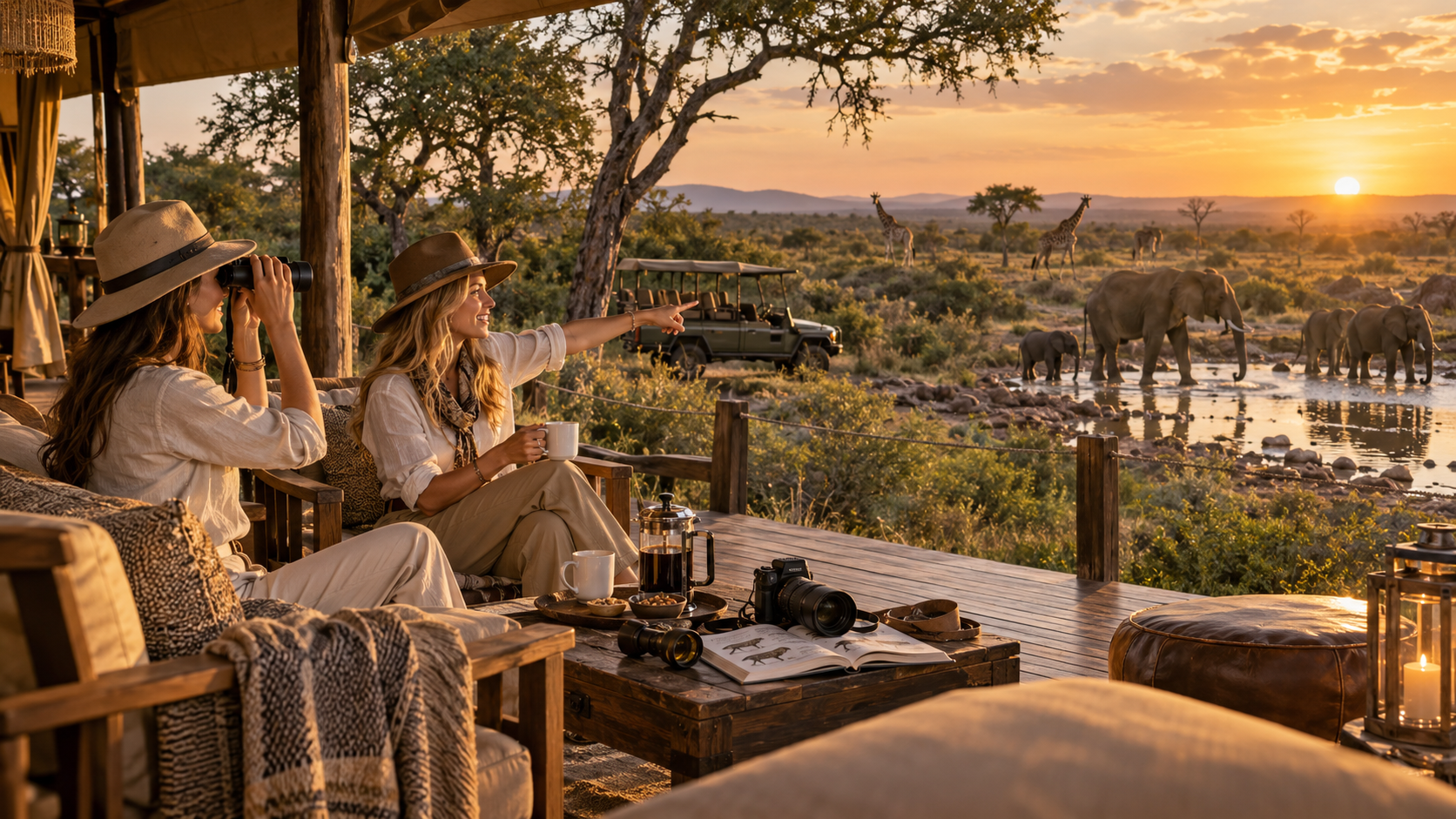

A luxury safari is not simply a normal safari with a nicer room.
The difference is usually in the details you notice only after arriving.
A guide who knows when to wait rather than chase another vehicle. A camp with only a handful of tents. Breakfast set up beside a river after the morning drive. A private deck where elephants wander past while you’re still drinking coffee.
Then there are the logistics.
Small aircraft instead of long road transfers. Private vehicles. Remote concessions where you can drive for an hour without seeing another safari truck. Camps positioned inside landscapes that feel genuinely wild rather than built around constant traffic.
That is what separates the best luxury safari destinations from places that are simply expensive.
Africa offers an enormous range of safari experiences, and they are not interchangeable. Botswana is built around water, wilderness and exclusivity. Kenya and Tanzania deliver classic savannah landscapes and dramatic wildlife concentrations. Rwanda combines high-end lodges with intimate primate encounters. Namibia feels almost otherworldly.
Choosing well depends on what kind of safari you actually want.
Here are the destinations worth understanding before you book.
1. Okavango Delta, Botswana
If privacy matters as much as wildlife, Botswana is difficult to beat.
The Okavango Delta spreads across northern Botswana in an extraordinary network of channels, floodplains, islands and seasonal wetlands. Instead of one enormous public park packed with vehicles, much of the high-end safari experience takes place in private concessions with limited camp numbers.
That changes everything.
A morning drive may involve lions crossing an open floodplain with no other vehicle nearby. Later, you might switch from a 4×4 to a traditional mokoro canoe and move quietly through reed-lined waterways.
The landscape changes with the annual flood.
Interestingly, the water arrives during Botswana’s dry season, transforming parts of the delta into a wildlife-rich mosaic precisely when surrounding areas are becoming drier.
Luxury camps here tend to be intimate.
Think canvas suites raised above the ground, plunge pools, outdoor showers and decks overlooking water rather than enormous resort buildings.
The downside?
Botswana is rarely inexpensive.
Remote camp locations, charter flights and low guest numbers push prices high.
But if your definition of luxury is space, wilderness and fewer people, the Okavango Delta makes a compelling case.
2. Maasai Mara, Kenya
Few landscapes look more like the classic idea of safari than the Maasai Mara.
Open grasslands stretch toward the horizon. Acacia trees appear almost perfectly placed. Lions rest beneath sparse shade while giraffes move across the plains in the distance.
During the Great Migration season, the atmosphere becomes much more dramatic.
Large numbers of wildebeest and zebra move through the greater Mara-Serengeti ecosystem, with river crossings attracting travelers from around the world.
The famous spectacle also creates the Mara’s biggest challenge: crowds.
This is where luxury planning matters.
Rather than staying only around the busiest sections of the national reserve, look at private conservancies bordering the Mara.
These areas usually restrict vehicle numbers and can offer experiences that are more difficult inside the reserve, including night drives and guided walking safaris.
That means you can experience the broader Mara ecosystem without joining ten vehicles around the same lion.
Luxury here does not necessarily mean removing yourself from wildlife.
It means choosing the part of the ecosystem where you can experience it more calmly.
3. Serengeti, Tanzania
The Serengeti is enormous.
That is both its strength and the reason planning matters.
The ecosystem covers vast grasslands and woodland areas across northern Tanzania, with different regions becoming particularly important at different stages of the year.
The Great Migration is not one event happening in one location.
It moves.
In the southern Serengeti, the calving season brings huge herds to the short-grass plains early in the year. As conditions change, animals move north and west, eventually reaching areas closer to Kenya.
So don’t simply book “the Serengeti.”
Book the part of the Serengeti that matches your timing.
Luxury camps handle this particularly well.
Some are permanent lodges in exceptional locations. Others operate as mobile or semi-mobile camps, following wildlife movements while still offering proper beds, private bathrooms and impressive meals.
That combination is appealing because the accommodation doesn’t remove you from the landscape.
At night, you still hear animals beyond the tent.
You just hear them from somewhere considerably more comfortable.
4. Sabi Sand, South Africa
For first-time safari travelers who want excellent wildlife viewing without giving up comfort, Sabi Sand is one of the easiest destinations to recommend.
The private reserve shares an unfenced boundary with Kruger National Park, which allows wildlife to move freely through the wider ecosystem.
Sabi Sand is especially famous for leopard sightings.
Individual animals have been observed across generations, and experienced guides and trackers know the territory exceptionally well.
Because the reserve is private, safari vehicles have more flexibility than they would in many national parks. Controlled off-road driving can allow guests to approach certain sightings more closely while still operating under reserve rules.
The lodge quality is another reason Sabi Sand works well for beginners.
There are properties with private pools, serious wine cellars, excellent food, spas and enormous suites.
Yet the wildlife remains very close.
You can spend the morning following leopard tracks and the afternoon beside your own plunge pool.
For travelers nervous about their first safari being too rustic, this is a very comfortable place to begin.
5. South Luangwa, Zambia
Zambia is a strong choice for travelers who want safari to feel adventurous rather than polished around the edges.
South Luangwa National Park is famous for walking safaris.
That changes the entire perspective.
Inside a vehicle, a giraffe gets your attention.
On foot, suddenly you’re noticing tracks, plants, insects, bird calls and the direction of the wind.
The landscape becomes more detailed.
Luxury camps in South Luangwa tend to preserve that sense of wilderness rather than replacing it.
Many are small, remote and built around excellent guiding.
Leopards are a major draw, along with elephants, lions, wild dogs and the extraordinary concentrations of wildlife that gather around remaining water during the dry season.
Night drives are another highlight.
The bush feels completely different after sunset, particularly when spotlights reveal nocturnal animals you’d rarely see during the day.
Zambia suits travelers who care more about guiding and immersion than marble bathrooms.
Although, these days, you may get both.
6. Volcanoes National Park, Rwanda
Not every luxury safari revolves around lions and elephants.
Rwanda offers something far more intimate.
Mountain gorillas.
Volcanoes National Park sits among forested volcanic landscapes in northwestern Rwanda and provides access to one of the world’s most extraordinary wildlife encounters: trekking to habituated mountain gorilla families.
The experience is controlled and limited.
Treks vary in difficulty depending on where the gorillas are that day. Some encounters require relatively manageable walks. Others involve steep, muddy forest terrain.
Then you find them.
That hour with the gorillas can feel strangely quiet.
A silverback sits only meters away.
Young gorillas move through vegetation.
The usual distance between human observer and wild animal feels suddenly very small.
Rwanda has developed a genuinely high-end lodge scene around this experience.
Several properties focus heavily on privacy, architecture, wellness and conservation.
The permit itself is expensive, and the overall trip can become costly quickly.
But for travelers looking for a once-in-a-lifetime wildlife encounter rather than a traditional game-drive safari, Rwanda belongs near the top of the list.
7. NamibRand and Sossusvlei, Namibia
Namibia is what you choose when landscape matters as much as wildlife.
Possibly more.
The Namib Desert creates scenes that barely look real.
Enormous orange dunes rise beside pale salt pans. Mountains appear in the distance through desert haze. At night, skies become extraordinarily dark.
Sossusvlei is the famous destination, particularly for the towering dunes and the surreal dead trees of Deadvlei.
For a more private experience, nearby private reserves such as NamibRand bring luxury camps into vast, sparsely populated desert landscapes.
This is not the destination for someone whose only goal is ticking off the Big Five.
Wildlife exists, including oryx, springbok and desert-adapted species, but the broader experience is about silence, scale and scenery.
Hot-air balloon flights are popular.
So are guided desert drives, walking experiences and stargazing.
And because the environment is so open, architecture becomes part of the experience.
Some of Namibia’s best lodges are designed to disappear into the landscape rather than dominate it.
That kind of luxury feels particularly appropriate here.
8. Ngorongoro Crater, Tanzania
Ngorongoro offers one of Africa’s most unusual wildlife environments.
The enormous volcanic caldera contains grassland, forest, wetlands and a remarkably concentrated population of animals within its walls.
From the crater rim, the entire landscape spreads beneath you.
Then you drive down.
Because wildlife density is high, the crater can provide an excellent opportunity to see lions, elephants, buffalo and other species within a relatively compact area.
It can also become busy.
Again, luxury is partly about strategy.
Staying near the crater rim allows you to descend early, before day visitors arrive from farther away.
Some high-end lodges also turn the location itself into the main attraction, with rooms and dining areas positioned toward sweeping crater views.
Ngorongoro works especially well as part of a longer northern Tanzania itinerary.
Combine it with the Serengeti rather than treating it as an isolated destination.
The landscapes are very different.
That’s exactly why the combination works.
9. Hwange National Park, Zimbabwe
Zimbabwe sometimes receives less attention than neighboring Botswana or South Africa.
That can work in your favor.
Hwange National Park is known for large elephant populations, varied habitats and excellent dry-season wildlife viewing.
Many safari areas feel genuinely spacious.
Luxury camps range from contemporary lodges to smaller tented properties positioned near waterholes.
Those waterholes become particularly interesting late in the dry season.
Animals gather.
Elephants arrive in groups.
Predators move through the area.
You may barely need to leave camp to watch something happen.
Zimbabwe can also pair beautifully with Victoria Falls.
That creates a very balanced trip:
Several days of wildlife in Hwange followed by waterfalls, river activities and a more conventional luxury-hotel experience near the Zambezi.
For a first safari, that combination can be remarkably easy.
10. Laikipia, Kenya
The Maasai Mara gets the fame.
Laikipia offers something different.
This highland region in central Kenya contains privately managed conservancies, ranches and wildlife areas where conservation, livestock and tourism often exist side by side.
The safari experience can be more varied than traditional game drives.
Horseback safaris.
Walking.
Camel trekking.
Night drives.
Private vehicles.
Some conservancies also play important roles in protecting endangered species, including black rhino.
For families, Laikipia can be particularly good because private properties often have more flexibility around daily schedules.
Children do not necessarily need to sit through four-hour drives twice a day.
There may be shorter outings, educational conservation experiences and activities designed around different ages.
That flexibility is luxury too.
11. Lower Zambezi, Zambia
The Lower Zambezi combines traditional safari with life on the river.
Elephants move between islands.
Hippos occupy channels.
Crocodiles rest along the banks.
Across the river lies Zimbabwe’s Mana Pools landscape, creating a huge wilderness corridor.
What makes the Lower Zambezi special is variety.
Morning game drive.
Afternoon canoeing.
Fishing.
Boat safari at sunset.
Walking safari the following day.
The scenery feels different from open savannah because water is constantly part of the experience.
Luxury camps tend to sit along the Zambezi itself, often with decks facing the river.
You may find yourself watching elephants crossing between islands while having lunch.
It is difficult to complain about the table view.
12. Private Reserves Around Kruger, South Africa
Sabi Sand is the most famous, but it isn’t the only high-end safari option around Greater Kruger.
Private reserves such as Timbavati and others within the broader ecosystem can provide excellent wildlife viewing with fewer vehicles than the public park.
This area works particularly well for travelers who want logistics to be straightforward.
Flights from Johannesburg connect with regional airports and private airstrips, while a wide range of lodge styles means you can choose anything from intimate tented camps to extremely polished suites.
South Africa also makes it easy to extend the trip.
Safari can be followed by Cape Town.
The Winelands.
The Garden Route.
That makes it one of the best destinations for a first luxury African trip where safari is important but not the only thing you want to do.
What Actually Makes a Safari “Luxury”?
It is not chandeliers.
At least, it shouldn’t be.
The most valuable luxury features on safari are often:
Private concessions: fewer vehicles and greater flexibility.
Excellent guides: probably the single most important element.
Small camps: fewer guests and more personal service.
Private vehicles: useful for photographers, families and travelers who want their own pace.
Remote locations: stronger feeling of wilderness.
Easy transfers: charter flights can turn an exhausting travel day into a short scenic flight.
Better room placement: a deck facing a river or waterhole can become part of the safari.
Then there are more conventional comforts.
Private pools.
Beautiful bathrooms.
Wine.
Spa treatments.
Excellent food.
All enjoyable.
But I would choose the outstanding guide over the oversized bathtub every time.
When Is the Best Time for a Luxury Safari?
There is no universal safari season.
Dry months often create easier wildlife viewing because vegetation becomes thinner and animals gather near water.
But green seasons can be beautiful.
Landscapes become lush.
Birdlife increases.
There may be newborn animals.
Rates can also be lower.
Migration-focused trips require more precise planning because animal movements depend on weather and rainfall rather than calendar appointments.
Gorilla trekking operates differently again.
Desert destinations such as Namibia have their own climate patterns.
The best time is therefore connected to the experience you want, not simply the destination name.
Ask the lodge or specialist advisor:
What will this place actually feel like during my dates?
That question is better than asking whether it’s “high season.”
How Long Should a Luxury Safari Be?
For a first safari, around seven to ten nights in the bush usually gives you enough time to settle into the rhythm without becoming exhausted by constant transfers.
Two or three different camps can work well.
More than that can start feeling like luggage management.
A strong itinerary might look like:
Three nights in one ecosystem.
Three nights somewhere different.
Then several nights at a beach, city or resort afterward.
Safari mornings often start early.
Very early.
Adding a few quiet days at the end is not a bad idea.
Your 5 a.m. alarm does not need to follow you home.
Should You Book a Private Safari?
If the budget allows and you have particular interests, yes.
Private vehicles are especially worthwhile for photographers.
You can wait longer at sightings.
Move when you want.
Stop for birds if everyone in your group actually likes birds.
Families benefit too because children may need shorter drives or different schedules.
Couples on special trips may simply value privacy.
Shared drives can still be excellent, particularly with small lodge groups.
The question is whether control over the schedule is worth the additional cost to you.
Luxury Safari Mistakes to Avoid
The most common mistake is trying to see too much.
Botswana, Kenya, Tanzania and South Africa may look close enough on a map.
They’re not interchangeable stops on a city break.
Flights, transfers and border crossings consume time.
Choose fewer areas and stay longer.
Another mistake is selecting accommodation before understanding wildlife location.
The most beautiful lodge in the wrong part of an ecosystem may give you a weaker safari than a simpler camp positioned perfectly.
Also, don’t ignore luggage restrictions on light aircraft.
Safari charter flights often have much stricter weight and bag-shape rules than international airlines.
That enormous hard-shell suitcase?
It may not be joining you.
The Best Luxury Safari Feels Wild First
Luxury should improve the experience.
It should not insulate you from it.
You should still hear animals at night.
Dust should probably reach your shoes.
Breakfast may happen outdoors.
Plans should occasionally change because a leopard appeared where nobody expected it.
That unpredictability is the entire point.
The best luxury safari destinations give you comfort without removing the sense that you are somewhere genuinely wild.
Botswana does it through privacy.
Kenya and Tanzania through enormous wildlife landscapes.
Zambia through guiding and adventure.
Rwanda through intimacy.
Namibia through space.
South Africa through an unusually easy combination of wildlife and sophisticated hospitality.
Choose the experience before the lodge.
Choose the guide before the bathtub.
And leave some room in the schedule for the thing nobody planned.
On safari, that’s often the moment you remember longest.
