


Italy rarely rewards travelers for rushing.
The country’s headline destinations—Rome, Florence, Venice, the Amalfi Coast—deserve their reputations, but some of the most memorable Italian experiences happen much farther from the usual checklist. They happen when you turn off a main road, drive another 20 minutes into the hills and suddenly find yourself in a stone village where an old man is carrying groceries across the piazza and the loudest sound is a church bell.
Italy has hundreds of these borghi: compact historic towns and villages shaped by mountains, agriculture, defensive architecture and centuries of local life. Italy’s official tourism board actively promotes its smaller villages as destinations for slower travel, traditional food and landscapes beyond the country’s major cities. (Italia.it)
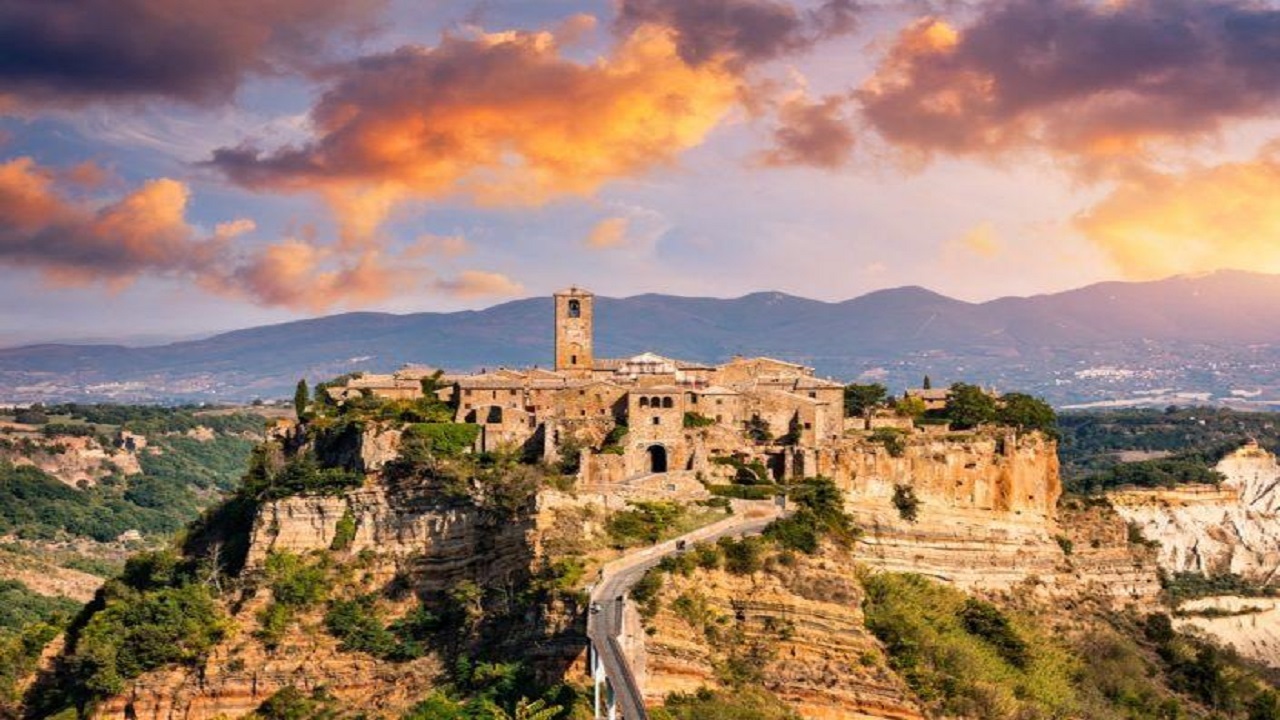
“Secret,” admittedly, is relative. A few places on this list are known among Italians and experienced European travelers. Civita di Bagnoregio certainly isn’t undiscovered anymore. But compared with Positano or San Gimignano, these villages can still provide the feeling many people are really looking for when they dream about rural Italy: time to wander without an itinerary, long lunches and streets that haven’t been designed entirely around tourism.
Here are ten villages worth building a detour around.
1. Apricale, Liguria
Most visitors to Liguria instinctively move toward the coast. That’s understandable—the Mediterranean is right there—but drive into the hills behind Bordighera and the landscape changes surprisingly quickly.
Apricale appears stacked onto a hillside, with stone houses seemingly leaning into one another and narrow passageways disappearing beneath arches. The village sits in the Nervia Valley of western Liguria, and regional tourism sources describe its historic center as a maze of stone houses and lanes dominated by the Castello della Lucertola. (La mia Liguria)
The best thing to do here is wonderfully uncomplicated: walk.
Don’t worry about creating a sightseeing schedule. Climb toward the main square, follow whichever alley looks interesting, stop at an artisan shop and order lunch when you get hungry. Regional tourism recommendations also point visitors toward local specialties and small craft shops, particularly when visiting in autumn. (La mia Liguria)
Best for: couples, photographers and travelers exploring the Italian Riviera by car.
2. Chianale, Piedmont
Chianale feels less like the Italy of vineyards and cypress trees and more like something from an Alpine folktale.
High in Piedmont’s Varaita Valley near the French border, the village sits at roughly 1,800 meters above sea level. Its traditional buildings are largely stone and timber, surrounded by the dramatic landscape of the Cuneo Alps. The official Piedmont tourism board lists Chianale among Italy’s recognized beautiful villages and highlights the area’s enduring Occitan culture. (visitpiemonte.com)
This isn’t somewhere I’d squeeze between two cities on a frantic itinerary. Chianale makes more sense as part of a mountain road trip, especially for travelers who enjoy hiking.
Spend the night nearby if you can. Mountain villages change character after day visitors leave, and early mornings here are part of the appeal.
Best for: hikers, road-trippers and anyone who thinks Italy should occasionally come with snow-capped peaks.
3. Dozza, Emilia-Romagna
A medieval village covered in contemporary art sounds like a concept created for Instagram. Dozza was doing it long before Instagram existed.
Located south of Bologna and only about six kilometers from Imola, Dozza has become an open-air gallery thanks to murals painted directly onto buildings throughout its historic center. Emilia-Romagna’s official tourism site says roughly a hundred murals can now be seen around the village, with the tradition linked to the Biennial of the Painted Wall. (Emilia Romagna Turismo)
The result is charming because the artwork isn’t confined to a museum. You might turn a corner expecting another faded medieval wall and instead encounter a huge contemporary painting.
Dozza also works beautifully within a food-focused Emilia-Romagna trip. Bologna, Imola and the surrounding wine country are close enough that you don’t have to choose between art, pasta and countryside.
Frankly, nobody should be forced to make that decision in Italy.
Best for: art lovers, food travelers and easy day trips from Bologna.
4. Santo Stefano di Sessanio, Abruzzo
If your imagined version of Italy contains stone houses, mountain air and quiet streets, Santo Stefano di Sessanio gets remarkably close.
The village sits on the L’Aquila side of the Gran Sasso within the Gran Sasso and Monti della Laga National Park. Like many communities in inland Abruzzo, it experienced significant depopulation during the 20th century before tourism and careful restoration brought new life to its historic buildings. (Italia.it)
There’s a ruggedness here that separates Abruzzo from the softer postcard landscapes of Tuscany.
Walk through the old center, then give yourself time for the surrounding countryside. Regional traditions are inseparable from the experience, particularly food. Santo Stefano is known for its local lentils, which have been cultivated in the area for centuries. (Italia.it)
Nearby Rocca Calascio also makes an excellent addition to the trip.
Best for: slow travel, mountain scenery, history and cozy autumn weekends.
5. Castelmezzano, Basilicata
Some villages sit beside mountains. Castelmezzano looks as though somebody squeezed it directly into them.
The village lies among the extraordinary rock formations of the Lucanian Dolomites in Basilicata, southeast of Potenza and close to neighboring Pietrapertosa. (Basilicata Turistica)
The approach is half the experience. Houses cluster below jagged peaks, and the entire settlement seems to belong to the rock rather than merely occupy it.
For adventurous travelers, there’s another reason to come. The well-known Volo dell’Angelo zip-line experience connects the dramatic landscape around Castelmezzano and Pietrapertosa, with sections stretching across the mountain terrain. (Basilicata Turistica)
You don’t need to launch yourself across a valley to appreciate Castelmezzano, of course. A slow walk and a good viewpoint will do just fine.
Best for: dramatic scenery, hiking and travelers combining Basilicata with Matera.
6. Sant’Agata de’ Goti, Campania
Campania tends to make people think of Naples, Capri and the Amalfi Coast. Sant’Agata de’ Goti offers something entirely different.
The historic village is dramatically positioned along a tufa cliff, with old buildings, bell towers and domes rising above the Martorano valley. One of its signature views is from the Vittorio Emanuele Bridge, where you can see the structures supporting the old town along the cliff. (Italia.it)
It also sits within an interesting wine region. Italy’s tourism board includes Sant’Agata de’ Goti on a Campania wine itinerary connected with the Taburno area and local Falanghina and Aglianico traditions. (Italia.it)
This is a good reminder that Campania becomes quieter very quickly once you move inland.
Come for the architecture, stay for lunch, and don’t rush back toward the coast.
Best for: architecture, wine and travelers based around Naples who want something less obvious.
7. Castelluccio di Norcia, Umbria
Castelluccio isn’t a classic polished hill town. That’s precisely why it belongs here.
At roughly 1,400 meters above sea level, it sits high in the Umbrian-Marchigian Apennines inside the Sibillini Mountains National Park. Below the settlement stretch the vast Piani di Castelluccio plateaus, with Mount Vettore rising beyond them. (Italia.it)
The area is particularly famous for its seasonal flowering, when fields around the plateau create broad sweeps of color. But Castelluccio shouldn’t be treated as a single-season photo opportunity. The open landscape is striking even when the flowers aren’t performing for the cameras.
Bring proper shoes and expect mountain weather rather than Mediterranean weather.
This is one place where the countryside matters even more than the village itself.
Best for: landscape photography, hiking and travelers who prefer huge horizons to crowded piazzas.
8. Gerace, Calabria
Gerace is the sort of place that makes you wonder why more Calabria itineraries don’t leave the coast.
Perched high above the surrounding landscape, the village offers views toward both mountains and coastline. Its architectural heritage reflects Calabria’s Byzantine and Norman history, with the Cathedral of Santa Maria Assunta among its most significant landmarks. (Italia.it)
Gerace has historically been associated with an extraordinary number of religious buildings, earning the nickname “city of a hundred churches.” (Italia.it)
The pleasure, though, isn’t counting churches. It’s wandering through pale stone streets, finding a viewpoint and realizing the Ionian Sea isn’t very far away.
Gerace pairs particularly well with Locri and Calabria’s Ionian coast, allowing you to combine archaeological sites, beaches and mountain villages without huge driving distances.
Best for: southern Italian history, architecture and coastal road trips.
9. Petralia Soprana, Sicily
There is much more to Sicily’s interior than a road connecting Palermo with Catania.
Petralia Soprana sits high in the Madonie Mountains, where its elevated position creates exceptional views across central Sicily. On clear days, several viewpoints around the town can reveal an enormous sweep of landscape, including views toward Mount Etna. (Itali.it)
The stone streets and churches are beautiful, but what really distinguishes Petralia Soprana is its setting. You feel high above the island rather than enclosed by it.
The wider Madonie area is also increasingly promoted around nature-based and community-focused tourism, making the village particularly suitable for a slower Sicilian itinerary. (Italia.it)
Stay for at least one night somewhere in the mountains rather than treating the interior as a day-trip curiosity.
Best for: Sicily repeat visitors, mountain drives and travelers escaping summer crowds on the coast.
10. Bosa, Sardinia
Bosa isn’t exactly unknown, but international travelers still routinely skip it while racing toward Sardinia’s more famous beaches.
That’s a mistake.
Bosa developed along the Temo River and is dominated by Malaspina Castle above a hillside of colorful houses. Italy’s tourism board describes it as unusual within Sardinia because of its riverfront setting; the historic Sa Costa district climbs toward the castle in a jumble of pastel facades and narrow streets. (Italia.it)
It works particularly well because you don’t have to choose between a village holiday and the sea. Sardinia’s west coast begins almost immediately outside town, with scenic roads, cliffs and comparatively quiet coves. (Italia.it)
Have coffee beside the river in the morning, explore the old town before lunch, then drive to the coast in the afternoon.
That’s a fairly convincing day.
Best for: colorful architecture, coastal road trips and travelers wanting a gentler side of Sardinia.
When Should You Visit Italy’s Smaller Villages?
For most of these destinations, May, June, September and October provide the easiest balance of comfortable weather and manageable visitor numbers.
Summer can work beautifully in high-altitude places such as Chianale and Castelluccio, where mountain conditions differ from Italy’s hotter cities. Southern villages can become intensely warm in July and August.
Autumn deserves special consideration. Ligurian and Alpine villages gain changing foliage, Abruzzo feels particularly atmospheric once temperatures drop, and restaurants across rural Italy shift toward mushrooms, chestnuts, lentils, game and other cooler-weather ingredients.
Winter can be wonderful too, but don’t improvise. Mountain road conditions, seasonal accommodation and restaurant opening schedules vary considerably. Check locally before making a long detour.
Do You Need a Car?
For this particular kind of Italian trip, usually yes.
Italy’s high-speed trains are excellent for connecting major cities. They are less useful when your goal is a tiny medieval settlement 1,200 meters up a mountain.
A rental car gives you the freedom to combine villages with landscapes that are often the real reason for going: the Gran Sasso around Santo Stefano, the Madonie around Petralia Soprana, the Lucanian Dolomites around Castelmezzano or the Varaita Valley around Chianale.
Just remember that historical centers often have restricted traffic zones. Park outside the old center whenever possible and walk in.
Also, leave extra time. The distance might look short on a map, but mountain roads in Italy have a habit of turning 30 kilometers into an unexpectedly scenic hour.
A Better Way to Experience Rural Italy
The temptation with a list like this is to collect villages.
Don’t.
Choose two or three within the same region and stay nearby. Visit one in the morning, have a long lunch, stop somewhere unplanned on the drive back and allow yourself to do absolutely nothing for part of the afternoon.
That’s when these places begin to make sense.
The appeal of Italy’s smaller villages isn’t that they contain a secret monument nobody else knows about. It’s that life still happens on a scale where you can notice individual things: laundry above an alley, the smell coming from a bakery, chairs arranged outside a bar before the evening crowd arrives.
Rome might give you the Colosseum. Florence gives you the Uffizi. Venice gives you the Grand Canal.
But somewhere in Abruzzo or Basilicata, you may remember a lunch in a restaurant with six tables, a road you hadn’t intended to take and a village whose name you could barely pronounce when you arrived.
Those are often the parts of Italy that follow you home.
