

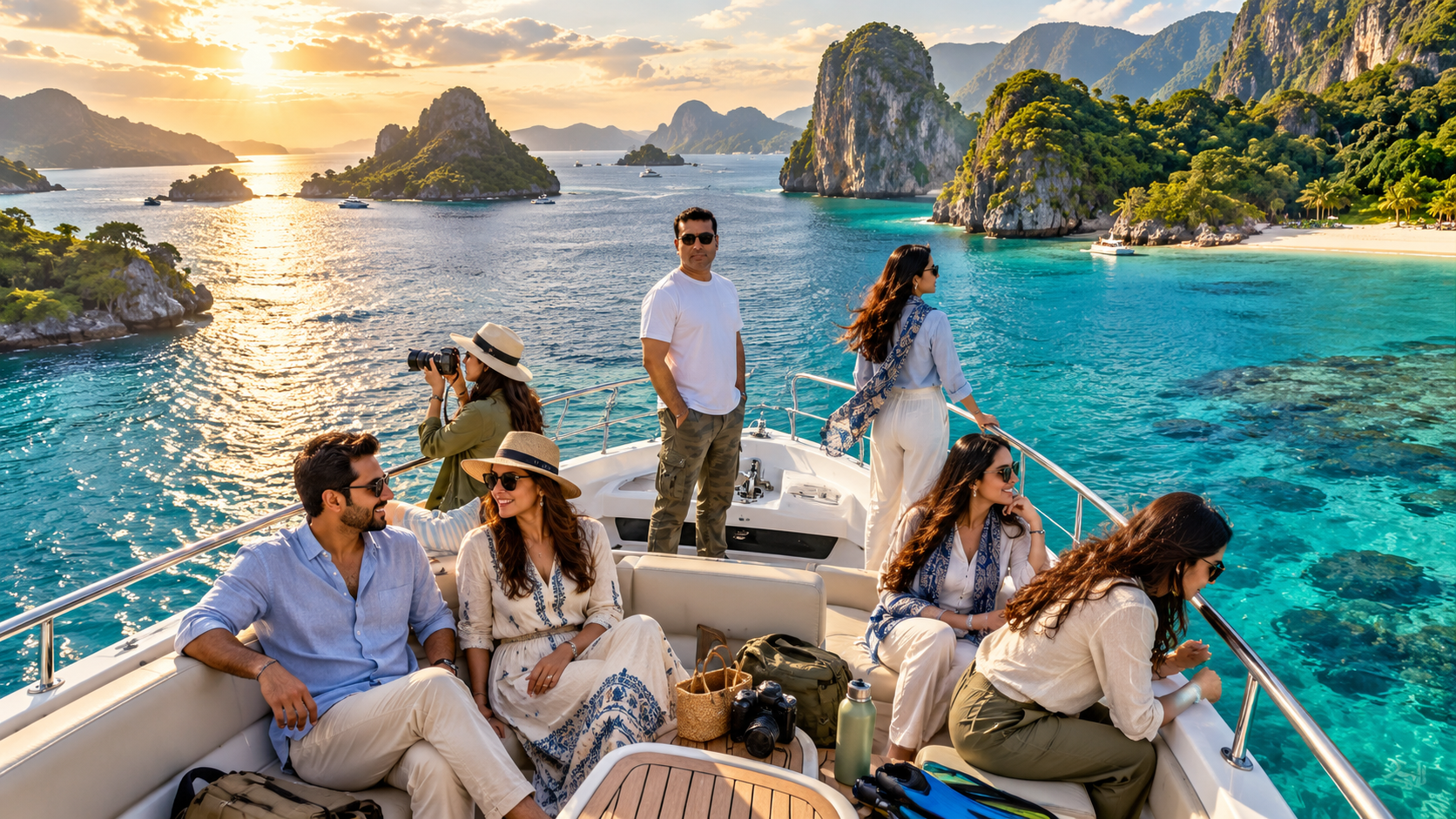

The first island is usually easy.
You arrive, drop your bag, find the water and briefly wonder why you would ever need to leave.
Then a boat appears.
Beyond the harbor is another island with different beaches, different food and perhaps an entirely different personality. Suddenly staying in one place starts to feel unnecessarily responsible.
That is what makes island hopping different from a normal beach vacation.
The best island hopping destinations are not simply places with lots of islands. Geography has to cooperate. Transport needs to be manageable. The islands should feel different enough that packing your bag again is actually worth it.
Greece does this with whitewashed Cycladic towns and a mature ferry network. The Philippines replaces tidy ferry ports with limestone lagoons and outriggers. Croatia combines medieval towns with remarkably clear Adriatic water. Fiji makes the journey progressively quieter as you move away from its main island.
And then there are destinations such as the Galápagos, where island hopping is less about beaches and more about wondering why a sea lion has apparently taken ownership of the path.
Here are the places worth building the whole trip around.
Best Island-Hopping Destinations at a Glance
| Destination | Ideal Route | Best Time | Ideal Length | Best For |
|---|---|---|---|---|
| Greek Cyclades | Paros ? Naxos ? Milos/Santorini | May–Jun, Sep | 10–14 days | Best overall |
| Palawan, Philippines | El Nido ? expedition ? Coron | Dec–Apr | 7–10 days | Spectacular scenery |
| Dalmatian Coast, Croatia | Split ? Hvar ? Kor?ula ? Mljet ? Dubrovnik | May–Jun, Sep | 8–12 days | Easiest European route |
| Thailand | Phuket/Krabi ? Phi Phi ? Koh Lanta | Nov–Apr | 7–10 days | Value + beaches |
| Indonesia | Bali ? Nusa Islands ? Gili Islands ? Lombok | Apr–Jun, Sep | 10–14 days | Variety |
| Fiji | Mamanucas ? Yasawas | May–Sep | 7–12 days | Relaxed Pacific escape |
| French Polynesia | Tahiti ? Mo?orea ? Huahine ? Bora Bora | Apr–Oct | 10–14 days | Luxury |
| Galápagos | Santa Cruz ? Isabela ? San Cristóbal | Dec–May or Jun–Nov | 8–12 days | Wildlife |
| Azores | Faial ? Pico ? São Jorge | May–Sep | 7–10 days | Hiking + nature |
| Grenadines | St Vincent ? Bequia ? Mustique ? Union Island | Dec–Apr | 7–12 days | Sailing |
1. Greek Cyclades — Best Overall Island-Hopping Destination
Greece is the easy answer.
Not because every Greek island is interchangeable. Quite the opposite.
The Cyclades work because places sitting surprisingly close together can produce completely different trips.
Paros balances beaches, attractive villages and enough nightlife to prevent evenings becoming too sleepy. Naxos feels larger and more grounded, with long beaches, mountain villages and excellent food. Milos gives you volcanic coastline and coves best explored from the water. Santorini supplies the enormous finish: caldera, cliffs and sunsets.
For 2026, Condé Nast Traveler’s Greece experts particularly recommend September for a first island trip because the sea remains warm, summer crowds have softened and major ferry routes are still operating frequently. Late May to early June is the other particularly attractive window.
The mistake is trying to collect islands.
Don’t.
Three islands in ten days feels like travel.
Five islands in ten days feels like baggage handling.
For a first trip, I would take:
Paros ? Naxos ? Milos
Add Santorini only if seeing the caldera matters more to you than having another relaxed beach island.
Why it wins: Probably the best combination of ferry infrastructure, food, beaches, villages and genuinely different island personalities.
2. Palawan, Philippines — Best for Scenery That Doesn’t Look Real
If Greece is the easiest recommendation, Palawan is the dramatic one.
El Nido’s landscape appears designed by somebody who thought normal tropical islands weren’t theatrical enough.
Dark limestone towers rise directly from turquoise water. Lagoons hide behind narrow openings. Small beaches appear beneath cliffs. Boats move between dozens of islands and islets.
Lonely Planet’s September 2026 Philippines guide highlights El Nido specifically for its limestone cliffs, lagoons, snorkeling, kayaking and extensive island-hopping opportunities.
But the stronger trip goes beyond El Nido.
Travel north toward Coron, ideally through a multi-day expedition rather than simply flying or taking the fastest ferry.
Coron shifts the experience toward lakes, reefs and wreck diving.
This is one destination where sleeping on simple islands, eating grilled fish and waking up beside the water can be more memorable than upgrading to the expensive hotel.
Why fly for it: Few places deliver such a high concentration of extraordinary landscapes from relatively small boats.
Best for: Adventure, snorkeling, kayaking and travelers who don’t mind getting wet while transferring luggage.
3. Croatia’s Dalmatian Coast — Best for Easy Logistics
Croatia is island hopping for people who like the concept but don’t want the logistics to become a hobby.
Split provides an obvious starting point.
From there, a classic route runs through Bra?, Hvar, Kor?ula and Mljet before finishing in Dubrovnik. Lonely Planet continues to recommend this Dalmatian sequence as the country’s classic island-hopping itinerary.
Each stop provides more than swimming.
Hvar brings restaurants and social energy.
Kor?ula has stone lanes, wine and a slower evening rhythm.
Mljet turns greener and quieter.
Dubrovnik makes a satisfying mainland finale.
The sea is astonishingly clear, though travelers expecting endless soft sand should know that Croatian beaches are frequently pebble or rock.
I would choose June or September rather than August.
You still get summer energy without quite as much competition for ferry seats, accommodation and waterfront tables.
Why it works: Island hopping without sacrificing history, restaurants or proper towns.
4. Thailand — Best First Tropical Island-Hopping Trip
Thailand may be the least intimidating tropical island-hopping destination on this list.
Transport exists.
Hotels exist at almost every budget.
Food is rarely a problem.
And if the boat journey has made you question your life choices, there is probably a massage somewhere near the pier.
For a clean first route, stay on one coast rather than jumping unnecessarily between Thailand’s Gulf and Andaman sides.
The Andaman Sea gives you Phuket or Krabi as gateways, followed by Phi Phi, Koh Lanta and smaller islands farther south.
Lonely Planet’s 2026 coverage calls the Andaman one of Thailand’s signature island-hopping regions, with limestone formations, reef-fringed islands and easy boat access from Phuket and Krabi.
Alternatively, stay in the Gulf and combine Koh Samui, Koh Phangan and Koh Tao, particularly if diving and nightlife are priorities. Lonely Planet’s current itinerary suggests allowing at least ten days for a wider Thai island route.
Why choose Thailand: Excellent value, easy independent travel and enough infrastructure to make spontaneity possible.
5. Bali, Nusa Islands, Gilis and Lombok — Best for Variety
Indonesia has so many islands that saying you are going “island hopping in Indonesia” is approximately as precise as saying you are traveling around Europe.
Keep it compact.
One of the easiest routes begins in Bali, moves to Nusa Lembongan or Nusa Penida, continues toward the Gili Islands, and finishes on Lombok.
The differences arrive quickly.
Bali gives you temples, restaurants and serious tourism infrastructure.
Nusa Penida brings cliffs and dramatic viewpoints.
The Gilis remove motor vehicles from the equation entirely. Gili Trawangan is livelier; Gili Meno quieter; Gili Air sits somewhere comfortably between them. Lonely Planet’s 2026 Indonesia coverage recommends the Gilis precisely because the three small islands deliver noticeably different experiences despite their proximity.
Lombok then gives you more space.
Best strategy: Don’t attempt Bali, Komodo and Raja Ampat in one “island-hopping” itinerary. Indonesia is nearly 5,000 km wide; Lonely Planet notes that longer hops often require flights as much as ferries.
Treat the country as several separate archipelagic trips.
6. Fiji — Best for Slowing Down
Fiji has more than 300 islands, which sounds like an invitation to create an absurd itinerary.
Resist.
For straightforward hopping, concentrate on the Mamanuca and Yasawa groups west and northwest of Viti Levu.
The journey itself gets better as you travel.
Resorts thin out.
Beaches grow quieter.
The landscape feels progressively farther from the international airport you landed at.
Lonely Planet’s updated 2026 Fiji guide recommends the Mamanucas for snorkeling and surfing while describing the Yasawas as stronger for isolation and marine adventures.
Fast ferries and resort boats connect Port Denarau with these groups, and the Yasawa route is especially practical for travelers visiting several islands.
Why choose Fiji: It delivers the remote-South-Pacific feeling without requiring private aircraft for every transfer.
7. French Polynesia — Best Luxury Island-Hopping Trip
French Polynesia is where island hopping becomes dangerous to your standards.
After a lagoon in Mo?orea and an overwater bungalow in Bora Bora, an ordinary hotel pool may never emotionally recover.
But the mistake is making the trip only about Bora Bora.
Start with Tahiti, move to Mo?orea, then consider Huahine or Ra?iatea/Taha?a before finishing with Bora Bora.
Lonely Planet’s September 2026 guide specifically recommends these less-visited Society Islands for travelers wanting something calmer beyond the famous names, and notes that inter-island flights should be booked early because aircraft are small and popular routes fill.
Unlike Greece or Croatia, this is not primarily a ferry-hopping trip.
Flights are often part of the itinerary.
That raises the budget, but also makes the contrasts extraordinary.
Best for: Honeymoons, milestone trips and travelers willing to spend significantly for landscape and privacy.
8. Galápagos — Best Island Hopping for Wildlife
The Galápagos turns the usual island formula upside down.
The beaches can be beautiful.
Nobody cares because there is a marine iguana sitting on them.
A land-based route can combine Santa Cruz, Isabela and San Cristóbal, using small inter-island ferries, while organized day tours reach protected wildlife sites.
Lonely Planet’s latest Galápagos guide notes that Puerto Ayora on Santa Cruz functions as the main ferry hub, with connections to Isabela, San Cristóbal and Floreana. It also warns that the small speedboat crossings can be rough.
If budget allows, the stronger approach may be hybrid:
a short expedition cruise plus several independent nights on land.
That gives you access to remote sites while preserving some freedom.
Why choose it: No other destination on this list makes wildlife such a constant part of the journey.
9. The Azores — Best Island Hopping Without a Tropical Beach
The Azores are for travelers who see the words “island vacation” and start looking for hiking boots.
This Portuguese Atlantic archipelago replaces palms with volcanoes, hydrangeas, pasture, crater lakes, waterfalls and black rock.
The easiest group to combine is the Triangle Islands: Faial, Pico and São Jorge.
Lonely Planet reports that these three are linked by year-round ferries, making them the strongest ferry-based island-hopping cluster in the Azores.
On Pico, climb or admire Portugal’s highest mountain.
On Faial, explore volcanic landscapes around Capelinhos.
On São Jorge, hike down toward coastal fajãs and reward yourself with local cheese afterward.
Atlantic weather is the catch.
Build slack into the schedule.
Why choose it: One of the best options for travelers who want islands without spending the entire vacation horizontally on sand.
10. The Grenadines — Best Island-Hopping Destination for Sailing
The Grenadines make the most sense when the boat becomes part of the holiday.
Start around St Vincent, then move south through Bequia, Mustique, Canouan, Mayreau and Union Island, depending on time and transport.
Some islands feel polished.
Others feel tiny enough that walking to dinner qualifies as your transport plan.
The distances are manageable, the water is remarkably clear, and sailing allows access to bays and small islands that conventional ferry itineraries cannot match as elegantly.
This is not the destination I would choose for someone who wants train-like schedules.
It is the one I would choose for someone who dreams about waking up, looking outside and deciding which island should provide lunch.
Best for: Sailing, couples, small groups and travelers prioritizing the sea itself.
Which Island-Hopping Destination Should You Choose?
The decision becomes easier if you stop asking which islands are “best” and decide what you want the journey to feel like.
For the easiest first trip, choose Greece or Croatia.
For maximum tropical scenery, choose Palawan.
For value, choose Thailand.
For variety, choose Indonesia.
For a remote Pacific feeling without extremely difficult logistics, choose Fiji.
For luxury, French Polynesia wins.
For wildlife, nothing here competes with the Galápagos.
For hiking and volcanic landscapes, take the Azores.
For sailing, head to the Grenadines.
That distinction matters because island hopping is essentially a holiday made from repeated travel days.
If you dislike the transport, you will dislike the trip.
The Three-Night Rule
Here is the planning rule I would use for almost every itinerary in this article:
Try to average three nights per main island.
Two nights frequently means:
arrive,
unpack,
have one proper day,
pack again.
That’s not island hopping.
That’s relocating luggage.
Ten days usually suits three meaningful stops.
Two weeks can support four.
A month gives you permission to become ambitious.
This is particularly important in Greece, where current travel specialists recommend allowing enough time between transfers instead of treating the ferry network like an urban subway.
Never Put Your Final Ferry on Flight Day
This is the island-hopping rule capable of saving the most money.
Do not stay on a smaller island until the morning of an expensive international flight.
Wind happens.
Mechanical problems happen.
Weather changes.
Small boats occasionally decide that your carefully designed itinerary is not their problem.
Spend the final night near your international departure airport whenever practical.
Athens after the Cyclades.
Split or Dubrovnik after Croatian islands.
Tahiti after Bora Bora.
Mainland Ecuador before a separate international connection after the Galápagos.
The extra hotel night may feel boring.
Missing a long-haul flight is significantly more interesting, but not in a good way.
The Best Island-Hopping Trips Have Fewer Islands
Island hopping creates a strange temptation.
Once you realize another island is only a ferry away, every island begins looking necessary.
It isn’t.
The purpose isn’t to accumulate ferry tickets.
It is to experience the difference between places.
Paros feels more interesting after Athens.
Naxos feels different after Paros.
A quiet Yasawa island becomes more powerful after Viti Levu.
Isabela feels extraordinary after busy Puerto Ayora.
That contrast is what makes the journey memorable.
So when choosing among the best island hopping destinations, don’t ask:
How many islands can I fit in?
Ask:
Which three or four would make the most interesting trip together?
For a first island-hopping vacation anywhere in the world, I would choose the Greek Cyclades for the overall balance of logistics, food, culture and beaches.
For scenery, Palawan would be difficult to beat.
And if the objective were simply to disappear somewhere warm and stop thinking about normal life for ten days?
I would take the boat north through Fiji’s Yasawas.
Probably slowly.
