

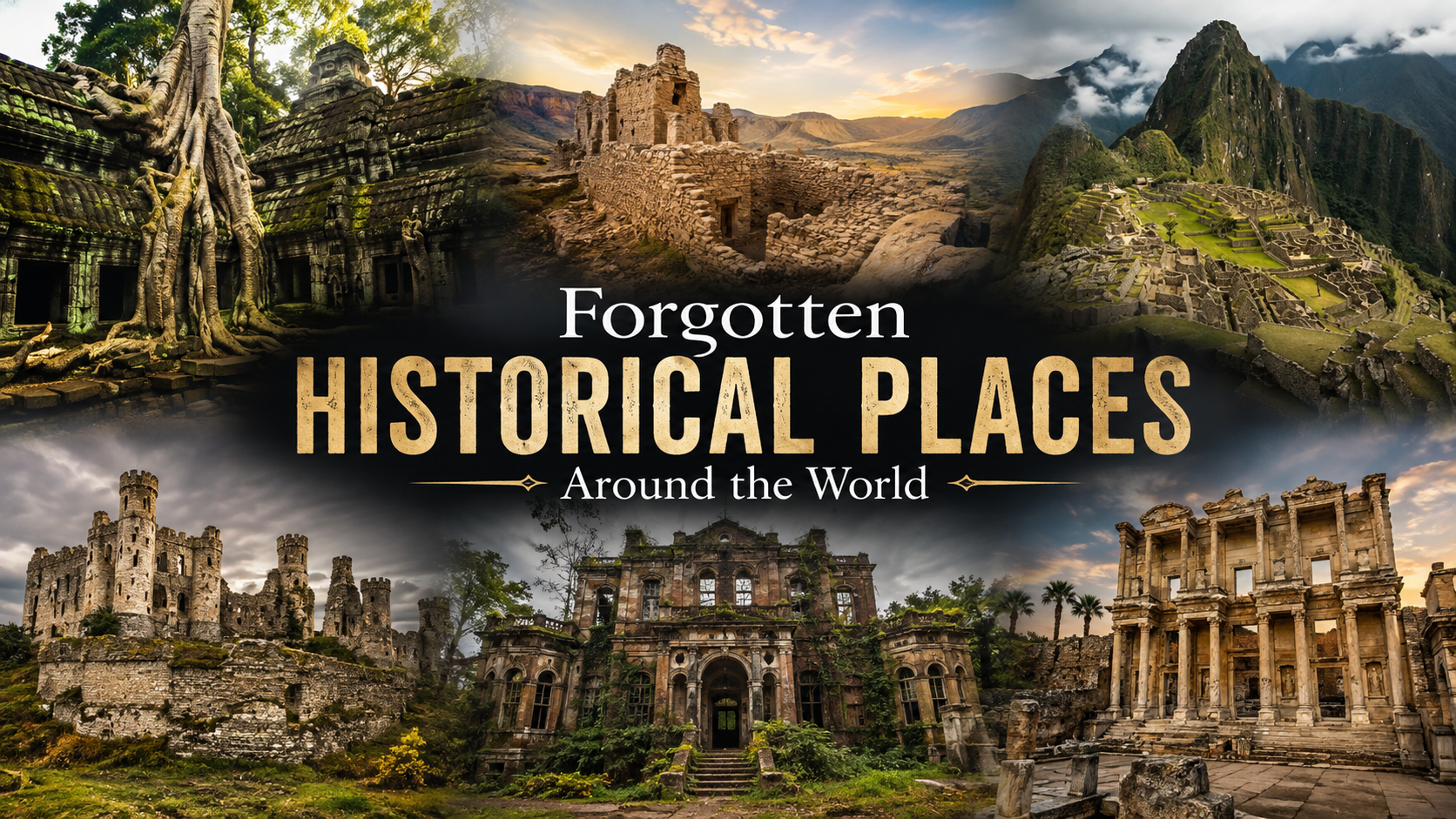

The world is full of places that time forgot. And honestly, that’s part of what makes them so compelling.
We all know about Pompeii, about Machu Picchu, about Petra. These are the rock stars of the archaeological world—places that draw millions of visitors a year, places whose names roll off the tongue with easy familiarity. But for every famous ruin that makes it onto the postcards, there are dozens of others that have slipped through the cracks of history. Entire cities, once thriving hubs of trade and culture, reduced to little more than footnotes. Civilizations that shaped the ancient world, only to be forgotten entirely until someone stumbled across their remains centuries later.
What follows is a journey through some of the most fascinating forgotten historical places on Earth. Some were swallowed by the sea. Others crumbled under the weight of war or neglect. A few were simply abandoned and left to the elements, their stories waiting for someone—anyone—to remember them again.
Hattu?a: The Capital of an Empire That Civilization Forgot
Let’s start in central Türkiye, on a steep hillside that doesn’t look like much at first glance. Today, the ruins of Hattu?a are marked by little more than stone foundations half-covered by dry grass. A few gates still stand, guarded by weathered statues of lions and sphinxes. But 3,300 years ago, this was the capital of the Hittite Empire, a superpower that went toe-to-toe with Egypt and Babylon.
At its peak, Hattu?a was home to as many as 7,000 people. It boasted vast temple complexes, towering brick walls, and a palace complex that must have been awe-inspiring to anyone approaching from the plains below. The Hittites fought the Egyptians, sacked Babylon, and signed the world’s first known peace treaty with Ramses the Great at the Battle of Kadesh.
And then, around 1180 B.C., they vanished.
Here’s the thing that gets me: the Egyptians, the Assyrians, the Babylonians—they all lived on in historical memory. People remembered them. But the Hittites? They were completely extinguished from the historical record. Scholars didn’t even know they existed until the late 19th century, when clay tablets and carvings at Egyptian temples set off an international hunt for their lost capital.
Today, you can walk among the ruins of Hattu?a and feel the weight of that silence. The mud-brick walls have long since crumbled. Floods and snowmelt have eroded the hillside, sending buildings full of clay tablets cascading down the slopes. What remains is a place that asks more questions than it answers—and that’s precisely why it matters.
Thimlich Ohinga: Kenya’s Forgotten Stone Fortress
If you mention Thimlich Ohinga in most conversations, you’ll probably get a blank stare. Maybe a confused “Thim… what?” Which is remarkable, considering this is a UNESCO World Heritage Site.
Hidden away in Kenya’s Migori County, far off the beaten track, Thimlich Ohinga is essentially a massive dry-stone fortress—built without mortar, with walls reaching roughly three to five metres high. These aren’t decorative walls. These are serious walls. The kind that make you stop for a second and think about the labour, planning, and organization behind them.
Nobody really knows exactly how old the site is. The safest estimate places it at least in the 16th century, possibly older. But the mystery runs deeper than just the dating. Who built these walls? How did the settlement evolve over time? And why was it abandoned?
For a place this important, the uncertainty is both fascinating and slightly ridiculous. Thimlich Ohinga points to labour, coordination, hierarchy—a level of social structure that too many people still seem oddly reluctant to imagine when it comes to pre-colonial Africa. Primitive, it most certainly was not.
Getting there, by the way, is not exactly a casual Sunday drive. Even with a 4WD, the approach can be a proper mission. But when you finally arrive, it doesn’t feel like you’ve rolled up to some polished heritage attraction. It feels like you’ve found something. And that is a very different feeling, and a much better one.
Dur Kurigalzu: A Babylonian Gem on the Outskirts of Baghdad
Just a 30-minute drive from the centre of Baghdad, you’ll find Dur Kurigalzu—a forgotten Babylonian gem nestled in the western countryside.
Founded sometime around the 14th century B.C. by the Kassite King Kurigalzu I, the city was once the capital of Babylonia. Its ziggurat, standing 171 feet high, is one of the ten oldest structures in Iraq. In bygone times, travelling by camel caravan, you’d know you were approaching Baghdad when you caught sight of that imposing ziggurat on the horizon.
Today, the site is in a dilapidated state. Garbage and empty beer bottles are scattered in the temple courts. Tedious graffiti covers the walls. The grand ziggurat, cleverly built with sun-dried bricks and reed mats, has eroded over centuries of environmental damage and neglect. It’s now at risk of collapsing.
What happened? War, mostly. After the 2003 invasion of Iraq, archaeological sites, museums, and even hospitals were ransacked by looters. Dur Kurigalzu wasn’t spared. Its modern restaurant, visitors centre, and museum were looted and vandalized. Consecutive governments have neglected the site, and pleas to the Ministry of Tourism and Antiquities have gone unanswered. The response is always the same: insufficient funds.
One archaeology enthusiast, Ali al-Makhzomy, started a culture project called “Bilweekend” to remind Iraqis of their rich history by organizing trips to ancient sites. “It saddens me how in Iraq people are indifferent regarding the oldest civilization in the world,” he said, “vis-a-vis other countries, where governments utilize archaeological sites for the benefit”.
Zakhiku: The City That Drought Revealed
Sometimes, the forgotten historical places reveal themselves in the most unexpected ways.
Around 3,800 years ago, the ancient city of Zakhiku was a thriving commercial hub on the Tigris River, founded by the Old Babylonian Empire. Merchants would float wooden beams down from the mountains, travel by donkey or camel with metals and minerals, and trade their wares in the bustling city. It was an important trading post for about 600 years before an earthquake forced its abandonment.
Then, in the 1980s, the city disappeared again—this time submerged under the waters of the Mosul Dam reservoir.
And then, in 2022, the climate crisis brought it back.
As severe drought gripped Iraq and water levels in the reservoir plummeted, the ruins of Zakhiku emerged from the receding waters. A team of local and German archaeologists sprang into action, uncovering new details about the city. The local people, who had no idea the ancient city lay beneath the reservoir, began visiting the site.
It’s a bittersweet story, isn’t it? A forgotten historical place, hidden for centuries, revealed by the very thing that threatens so much of our shared heritage. Climate change is drying up rivers, melting glaciers, and exposing artefacts that have been buried for millennia. It’s a reminder that the past is never really gone—it’s just waiting for the right conditions to resurface.
Thonis-Heracleion: Egypt’s Sunken City
Not all forgotten places are on land. Some of the most extraordinary ones lie beneath the waves.
For thousands of years, the ancient Egyptian city of Thonis-Heracleion existed only in a few rare inscriptions and ancient texts. No trace of it was visible along the shores of the Nile Delta. It was a city that many assumed was mythical—a legend, nothing more.
Then, in 2000, maritime archaeologist Franck Goddio discovered the truth. The entire city had sunk beneath the Mediterranean Sea.
Searching about four miles off today’s coastline, under 33 feet of water, Goddio’s team found the remains of a temple to Amun, a system of canals, more than 70 sunken ships, and hundreds of anchors. Among the treasures: figures of sphinxes and rulers, rings, coins, a massive red granite statue of the Egyptian god Hapy, luxury Greek ceramics, and even 2,400-year-old wicker baskets still filled with fruit.
How did this vibrant city vanish? Investigators believe a combination of earthquakes, tidal waves, and soft, liquefying soil caused Thonis-Heracleion to sink under its own weight.
It’s a haunting thought. A city that once boomed with trade and culture, on par with Babylon and Pompeii, simply swallowed by the sea and forgotten for two millennia.
The Ones We’ve Lost
Of course, not every forgotten place has been rediscovered. Some have been lost forever.
The Buddhas of Bamiyan in Afghanistan once stood 55 and 38 metres tall, carved into sandstone cliffs along the Silk Road. In March 2001, they were destroyed by the Taliban. The ancient city of Palmyra in Syria, which thrived from the 1st to 2nd centuries AD, saw its Temple of Bel, Temple of Baalshamin, and Arch of Triumph reduced to rubble during the Syrian Civil War. The Old City of Aleppo, one of the world’s oldest continuously inhabited cities, was largely destroyed by intense fighting between 2012 and 2016. The Great Mosque of al-Nuri in Mosul, famous for its leaning 12th-century minaret, was destroyed in June 2017.
In April 2015, a 7.8-magnitude earthquake in Nepal collapsed the 60-metre Dharahara Tower and damaged or destroyed 691 historic structures across the Kathmandu Valley.
These are the forgotten places we can’t visit anymore. The ones that exist only in photographs and memories. And their loss is a reminder that forgetting isn’t always a slow, gentle process—sometimes, it’s sudden and violent.
A Final Thought
The forgotten historical places of the world aren’t just tourist attractions waiting to be discovered. They’re reminders of our shared fragility. Civilizations rise, they flourish, and then—for reasons we don’t always understand—they fade. Wars, earthquakes, climate change, neglect—the forces that erase cities from the map are the same forces that shape our own world today.
So the next time you’re standing among the ruins of some ancient place, take a moment to really feel it. The stones beneath your feet were once someone’s home, someone’s temple, someone’s livelihood. The silence around you was once the sound of markets and prayers and children laughing.
That’s the thing about forgotten places. They wait. For centuries, sometimes millennia. They wait for someone to remember them again.
And when that someone finally arrives—a traveller, an archaeologist, a curious soul who wandered off the beaten path—the forgotten place comes alive once more. Not in the way it once was, perhaps. But alive nonetheless, in the stories we tell about it, in the questions we ask, in the wonder we feel.
That’s the power of forgotten historical places. They remind us that nothing is ever truly lost. It’s just waiting to be found.
