

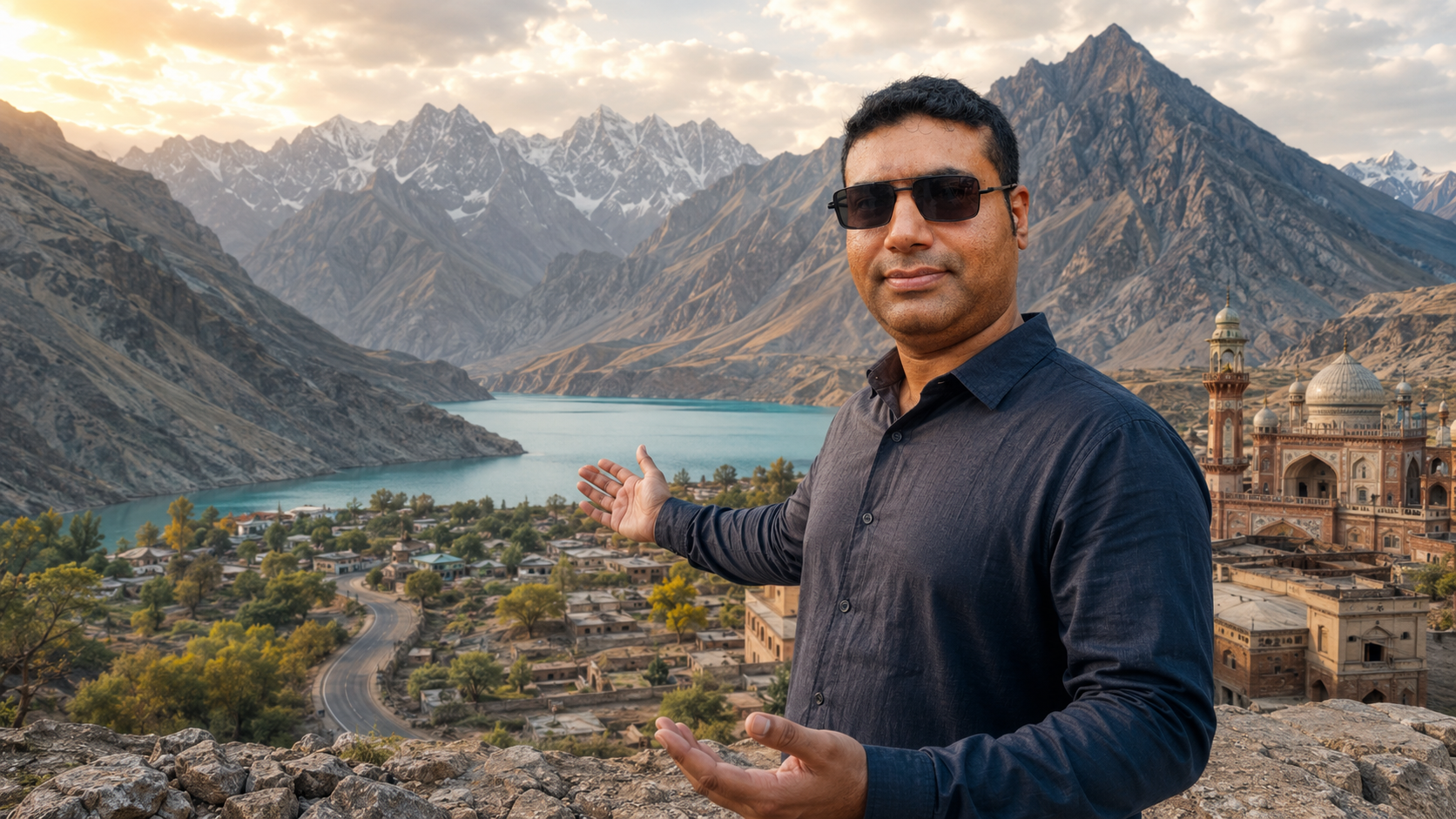

Pakistan is difficult to sum up in a single photograph.
Show someone the turquoise lakes and enormous peaks of Gilgit-Baltistan, and they might assume the country is mostly wilderness. Show them Lahore’s Mughal architecture and crowded food streets, and suddenly it feels like a destination built around history and culture. Spend a few days in Karachi and you meet an entirely different Pakistan again—fast, coastal, chaotic and permanently hungry.
That’s what makes traveling here interesting.
Pakistan doesn’t offer one neat travel experience. It gives you several countries’ worth of landscapes, languages, food traditions and cultural rhythms inside one border.
The north has some of the world’s most dramatic mountain scenery. Punjab is filled with historic cities and agricultural plains. Sindh carries centuries of Sufi, Islamic and ancient Indus Valley heritage. The country’s official tourism authority highlights everything from the Karakoram ranges to the Indus delta, along with trekking, mountaineering and desert experiences.
But Pakistan is also a destination that rewards preparation. Distances are large, mountain weather changes plans, travel conditions vary by region, and the places that look close together on a map can require an entire day on the road.
So, where do you begin?
This Pakistan travel guide covers the places worth building a trip around, what to eat, when to go, how to move around and some practical things worth knowing before you arrive.
Start With Lahore for History, Food and Street Life
If you want to understand Pakistan through one city first, Lahore makes a strong introduction.
It is grand and messy in equal measure.
Inside the Walled City, narrow streets twist between old houses, workshops, food stalls and mosques. Then, almost without warning, you step into the scale of Mughal Lahore.
The Badshahi Mosque is the obvious landmark, and for good reason. Its enormous courtyard, red sandstone exterior and white marble domes have defined Lahore’s skyline for centuries. Right beside it sits Lahore Fort, another essential stop if you’re interested in Mughal architecture.
But don’t rush between monuments.
Some of Lahore’s best moments happen between them.
Walk through Delhi Gate toward the old city. Stop for chai. Watch shopkeepers arranging fabric, spices and jewelry. Look above street level, where old wooden balconies still survive over modern storefronts.
And then there is the food.
Lahore takes eating seriously. Try a traditional breakfast of halwa puri if you’re prepared for something substantial first thing in the morning. Later, look for chargrilled kebabs, chicken karahi, nihari, paya and freshly baked naan.
For dessert, there’s falooda, jalebi, kulfi or whatever the person you’re eating with insists is “the famous one.”
In Pakistan, that last category can become quite large.
Islamabad Is Pakistan at a Slower Pace
Islamabad feels almost surprising after Lahore.
The roads are wider. The city is greener. Margalla Hills sit directly behind it, and entire neighborhoods can feel unusually calm for a national capital.
Faisal Mosque is the landmark most visitors recognize immediately. Its angular architecture is very different from Pakistan’s older Mughal mosques, and the mountain setting makes the building particularly striking near sunset.
For views over the city, head toward the Margalla Hills. Shorter walks and longer hiking routes lead into the forested slopes, although local conditions should always be checked before setting out.
Islamabad also works well as a practical beginning or end to a northern Pakistan itinerary. Many travelers use the capital before continuing toward Gilgit-Baltistan.
Just don’t treat it purely as a transit stop. Spend a day here, slow down and have a proper dinner before the mountain roads begin.
You’ll appreciate the decision later.
Hunza Valley Is the Pakistan You’ve Seen in Travel Photographs
Then comes the north.
Hunza is one of those places where photographs can look slightly exaggerated until you arrive and discover that the real landscape is somehow bigger.
The valley is surrounded by enormous Karakoram peaks, with villages, orchards and terraced fields scattered along steep mountain slopes. Depending on the season, those orchards may be covered in spring blossom, deep green summer foliage or brilliant autumn gold.
Karimabad makes a convenient base.
From here, visit Baltit Fort, perched above the settlement, and Altit Fort in the neighboring village. Both help give context to the valley beyond its scenery. Hunza was historically its own princely state, and these buildings tell part of that story.
Further north, Attabad Lake provides one of the region’s most recognizable scenes: intensely blue water enclosed by barren mountains. Continue toward Passu and the sharp peaks of the Passu Cones appear above the Karakoram Highway.
The scenery becomes increasingly stark as you approach the upper Hunza region.
This isn’t really a destination for racing through a checklist.
Leave time to sit somewhere.
Order tea. Watch the light move across the mountains. You’ll understand why.
Skardu Is for Landscapes That Feel Almost Impossible
Skardu is another gateway to Pakistan’s high mountains, but it feels different from Hunza.
The scenery here can shift from lakes and green valleys to enormous barren mountains and cold desert within a surprisingly short distance.
Upper Kachura Lake is quieter and more natural than some of the area’s developed attractions. Lower Kachura has its own dramatic mountain setting, while the surrounding region offers routes toward Shigar and Khaplu.
The drive to Shigar is worth making partly for the landscape and partly for Shigar Fort, an old fort that has been carefully restored.
Then there is the Sarfaranga Cold Desert.
Sand dunes framed by snow-covered mountains aren’t something you see every day. The contrast is strange, stark and unmistakably Skardu.
Travel around Gilgit-Baltistan requires flexibility. Mountain roads can be affected by weather and landslides, while flights serving Skardu and Gilgit can change at short notice. Build a little breathing room into your itinerary instead of arranging an international flight immediately after a mountain-sector flight.
One buffer day can save a great deal of stress.
Don’t Ignore Pakistan’s Southern Side
Northern Pakistan gets much of the international travel photography, but it shouldn’t become the entire story.
Karachi is the opposite of a quiet Himalayan valley.
It’s huge, energetic and occasionally exhausting. It is also one of the best places in the country to eat.
The city’s character comes partly from migration. Communities from across Pakistan have settled here over generations, bringing their own cuisines with them. That means a few days of eating around Karachi can move from biryani and kebabs to seafood, bun kebabs and regional dishes from elsewhere in the country.
Visit the white marble Mazar-e-Quaid, explore older areas of the city and make time for the coast.
For travelers interested in much older history, Sindh is also associated with Mohenjo-daro, one of the great urban sites of the ancient Indus Civilization.
Pakistan’s story, after all, begins long before its modern borders.
When Is the Best Time to Visit Pakistan?
There isn’t one perfect month because Pakistan’s geography varies so dramatically.
For Lahore, Islamabad and much of the plains, October through March is generally more comfortable than peak summer. Lahore in June is an entirely different proposition from Lahore in December.
For Hunza, Skardu and other high-altitude destinations, the main travel period generally falls between spring and autumn, although exact road access depends on elevation and weather.
Spring brings blossoms to northern valleys.
Summer offers the broadest access for trekking and mountain travel.
Autumn can be spectacular in Hunza, particularly when poplar and apricot trees turn shades of yellow, orange and red.
Winter is beautiful but changes the trip considerably. High passes may close, road journeys become less predictable and temperatures can fall sharply.
Pack for the region you’re actually visiting, not simply for “Pakistan.” A person packing for Karachi and someone packing for Khunjerab Pass are effectively preparing for different climates.
What Should You Eat in Pakistan?
Come hungry.
Pakistani cuisine changes significantly between regions, and trying to identify a single national dish quickly becomes an argument nobody needs to win.
In Punjab, you’ll encounter rich curries, grilled meats, lentils, breads and hearty breakfasts. Karachi is famous for everything from biryani to street snacks and seafood. Peshawari cooking is known for its simpler approach to meat, including chapli kebab and traditional karahi. Northern regions add their own breads, soups, dumplings and locally grown ingredients.
Some essentials worth trying are biryani, chicken or mutton karahi, nihari, chapli kebab, seekh kebab, daal, chana, paratha and freshly baked naan.
And chai.
There will be chai.
At hotels, roadside stops, offices, shops, homes and places where you thought tea would have no logical reason to appear.
It will appear anyway.
Accepting a cup is often about more than the drink itself. Hospitality plays an important role in Pakistani social life, and visitors frequently discover that conversations stretch much longer than planned once tea arrives.
Getting Around Pakistan
Domestic flights can save enormous amounts of time, particularly when traveling between major cities and northern areas.
Road travel, however, shows you more of the country.
Private cars with drivers are common for tourism and can make sense for families or small groups, particularly in areas where public transportation isn’t convenient for sightseeing.
Intercity buses connect major destinations and range from basic services to more comfortable coaches. Ride-hailing services are available in major cities, although availability varies.
Train travel has long been part of domestic life, but travelers should check current security guidance and conditions before choosing a route. As of September 2026, the UK’s FCDO advises against using Pakistan’s railway network because of terrorism risk.
In the mountains, distance becomes deceptive.
A route that seems short on Google Maps may involve narrow roads, construction, security checks or landslide delays. Avoid building an itinerary where every day requires reaching another distant destination.
Pakistan travels better when you leave space between things.
Visas and Entry Requirements
Visa requirements depend on your nationality, so check the rules for your passport rather than relying on an old blog post or social-media video.
Pakistan’s Ministry of Foreign Affairs states that the government’s official online visa system is operational, with applications handled through the Pakistan Online Visa portal.
Use the official government portal and confirm requirements before buying non-refundable travel arrangements, particularly because documentation and processing conditions can differ between nationalities and visa categories.
Passport validity requirements should also be checked for your specific situation before departure.
Culture, Clothing and Everyday Etiquette
Pakistan is socially conservative compared with many Western tourism destinations, although attitudes differ considerably between big cities, smaller towns and rural areas.
Modest clothing is the easiest approach for visitors.
Women don’t generally need to adopt Pakistani clothing to travel, but loose trousers, long skirts, shirts, tunics and tops that cover the shoulders are practical choices. A lightweight scarf is useful, particularly when visiting mosques or religious sites.
Men will generally be more comfortable avoiding very short shorts outside resorts or highly informal settings.
You may also be surprised by how often people ask where you’re from, whether you’re married or what you think about Pakistan.
These questions can feel unusually personal depending on your culture, but they’re often simply conversation starters.
Photography deserves some sensitivity too. Ask before closely photographing people, particularly women, children and anyone engaged in prayer.
A Note About Safety
Pakistan should neither be portrayed as universally dangerous nor discussed as though security concerns don’t exist.
Conditions vary significantly by region.
As of September 2026, official foreign-government advice includes restrictions or warnings for several parts of Khyber Pakhtunkhwa, Balochistan, areas near international borders and the Line of Control, among other locations. Conditions can also change because of protests, regional tensions or security incidents.
Before traveling, check your own government’s current advisory, speak with reputable local operators where appropriate and verify conditions for the specific route you’re planning—not simply Pakistan as a whole.
For remote mountain travel or trekking, local expertise becomes particularly important.
How Long Should You Spend in Pakistan?
Ten days can give you a strong introduction, but two weeks is much better.
A first trip might begin with a couple of days in Lahore, continue to Islamabad, then devote most of the remaining time to Hunza or Skardu rather than attempting both at high speed.
With three weeks, the country opens up considerably. You can slow down in the north, include several historical cities or explore more of Sindh and Punjab.
The temptation is to see everything.
Resist it.
Pakistan is geographically too large and logistically too interesting for that approach.
Pakistan Is Better When You Stop Trying to Finish It
Maybe that’s the most useful thing to know before coming.
Pakistan isn’t really a destination you complete.
You can spend one trip between Mughal forts and old bazaars, another between glaciers and mountain villages, and another eating your way through Karachi while barely touching what came before.
The impressive places are certainly impressive.
Seeing the Passu Cones for the first time matters. So does walking into the enormous courtyard of Badshahi Mosque or watching evening light disappear behind the mountains in Hunza.
But people often remember smaller moments just as clearly.
The roadside cup of tea you didn’t plan to stop for. A shopkeeper who keeps talking for half an hour. Someone insisting you try another plate of food after you’ve already explained that you cannot possibly eat another bite.
That’s Pakistan too.
Come with a plan, but don’t make it so rigid that the country has no opportunity to interrupt it.
Those interruptions may turn out to be the best part of the journey.
