

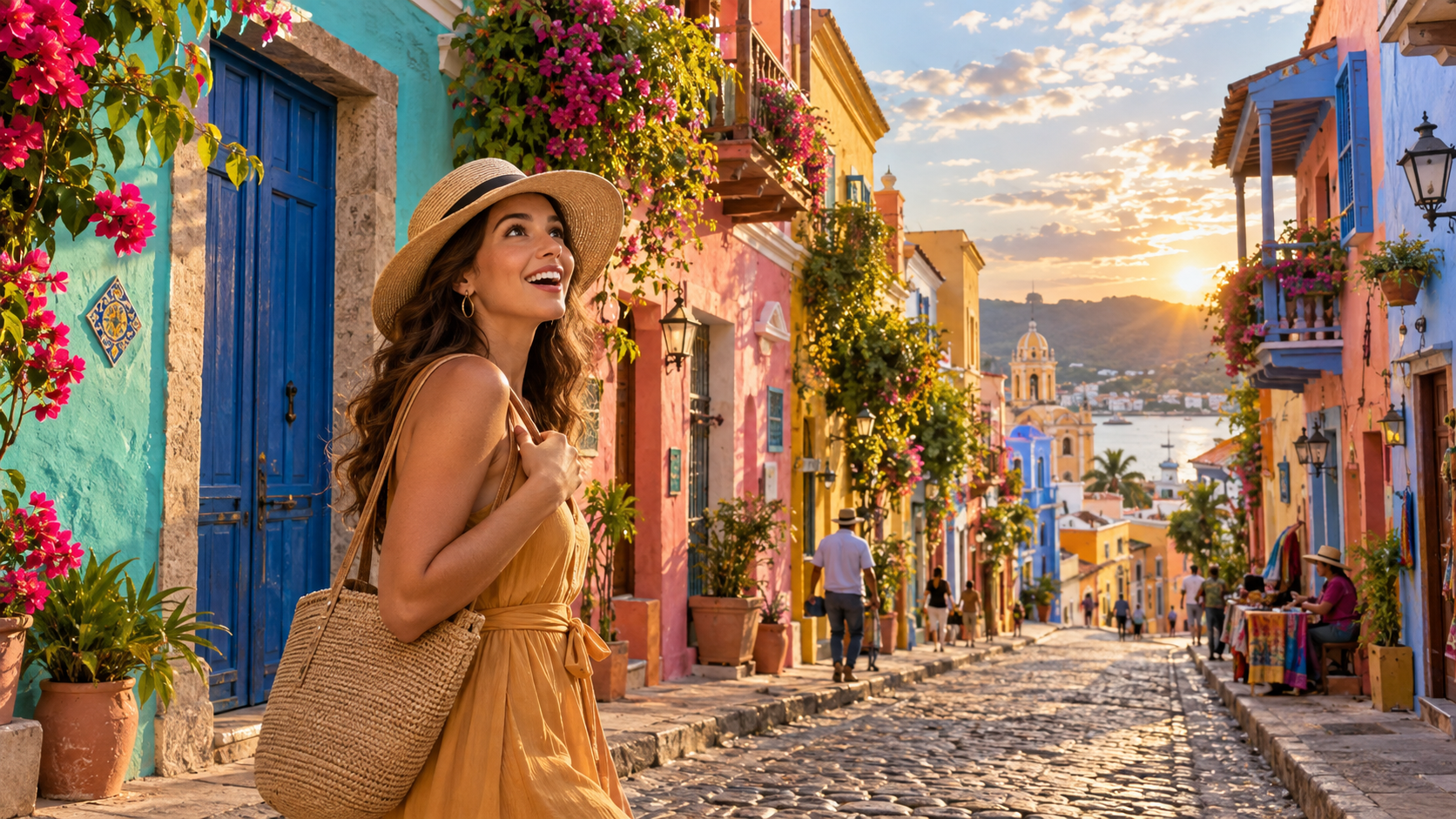

Some cities impress you with scale.
Others do it with color.
A blue staircase disappears between whitewashed houses. A row of buildings shifts from coral to yellow to turquoise. Laundry hangs above an alley that already looks like somebody adjusted the saturation too far.
Except nobody did.
Color can completely change the way a city feels. It makes ordinary streets memorable. It turns apartment blocks into landmarks. In some places, color comes from centuries-old building traditions. In others, it reflects local identity, religion, climate, materials, or simply a willingness to make a street look cheerful.
And then there are cities where one particular color has become almost inseparable from the destination itself.
Jaipur is pink. Jodhpur is blue. Chefchaouen is even bluer. Guanajuato seems to have rejected the idea of choosing one color at all.
The most colorful cities around the world aren’t always colorful from one end to the other. Sometimes a single neighborhood defines the image we remember. But that’s part of the fun. You can walk through an ordinary street, turn a corner, and suddenly find yourself in a place that looks painted by hand.
Here are twelve cities where color is part of the travel experience.
1. Jaipur, India
Jaipur’s nickname isn’t subtle.
It’s the Pink City.
The historic center is famous for its warm terracotta-pink façades, a color that gives entire streets a surprisingly unified appearance. The effect becomes especially striking near landmarks such as the Hawa Mahal, where hundreds of small windows and decorative details catch the light differently throughout the day.
What’s interesting about Jaipur is that the color doesn’t feel decorative in isolation.
It’s part of the city’s architectural identity.
Markets, gateways and historic buildings repeat similar warm shades, while bright textiles, flower garlands and painted signs bring additional color at street level.
Early morning is particularly good for walking through the old city. The pink walls look softer before midday, shopkeepers begin opening their shutters, and the streets haven’t yet reached full volume.
By noon, Jaipur is louder, hotter and considerably busier.
Also very Jaipur.
2. Chefchaouen, Morocco
If Jaipur chose pink, Chefchaouen committed to blue.
The old medina in this northern Moroccan city is famous for streets, staircases, doorways and walls painted in varying shades of blue.
Some are pale and almost powdery.
Others are deep cobalt.
Together, they create one of the most recognizable urban landscapes in Morocco.
The best part is that Chefchaouen’s color isn’t confined to one landmark. You experience it while walking.
A narrow blue alley might lead to a small square. Painted steps disappear beneath flowerpots. Cats sleep against walls that look almost unreal in photographs.
The town sits against the Rif Mountains, which adds another layer to the setting. Blue streets below, rugged landscape above.
It can become busy in the middle of the day, particularly around the most photographed lanes, so early mornings are worth the effort.
You get quieter streets.
And, more importantly, fewer people accidentally standing in your carefully composed doorway photograph.
3. Guanajuato, Mexico
Guanajuato doesn’t have a single signature color.
It has all of them.
Built across hills and valleys in central Mexico, the city is packed with houses painted orange, yellow, red, green, pink and blue. From above, the buildings appear stacked on top of one another, creating one of the most colorful urban views in Latin America.
Street level is equally interesting.
Narrow alleys twist between tall buildings. Plazas open unexpectedly. Colonial façades sit beside small restaurants, churches and theaters.
The city’s topography makes the color even more dramatic.
Head to a viewpoint and the entire urban landscape spreads below you like a mosaic.
Unlike carefully planned modern developments, Guanajuato’s beauty comes from irregularity. Rooflines don’t match. Streets curve strangely. Buildings lean into hillsides.
That’s what makes it work.
4. Cartagena, Colombia
Cartagena seems built for late-afternoon light.
The historic walled city is filled with colonial buildings painted in shades of mustard yellow, coral, pink, blue and white. Wooden balconies overflow with bougainvillea, while large doors and shutters add deep greens and blues to the streets.
There are plenty of grand buildings here, but the smaller residential streets often feel more memorable.
One house might be bright yellow with a blue doorway. The next is pale pink with white trim. Across the road, purple flowers spill down from a balcony.
Nothing matches.
Everything somehow works.
The Caribbean setting helps too.
Bright sunlight makes the colors look sharper during the day, while evenings soften the entire city into warmer tones.
Cartagena can feel polished in the most visited areas, but it still has movement and noise. Vendors pass by. Music appears from somewhere. Horse-drawn carriages move through the old streets.
It’s colorful in more ways than one.
5. Willemstad, Curaçao
Willemstad looks like somebody took traditional Dutch architecture and decided it needed a Caribbean color palette.
The waterfront is lined with narrow historic buildings painted in yellow, turquoise, pink, blue, orange and green. Their decorative gables are unmistakably European in shape, but the colors make the scene feel completely different.
The result is distinctive enough that one photograph often tells you exactly where you are.
The neighborhoods around Punda and Otrobanda offer some of the best walking, with historic streets, cafés and waterfront views.
Then there is the floating Queen Emma Bridge, which connects the two sides of the harbor.
Standing there, with brightly painted façades reflected in the water, it becomes clear why Willemstad regularly appears in lists of the world’s most photogenic cities.
It’s cheerful without feeling artificial.
6. Valparaíso, Chile
Valparaíso is colorful in a messier, more creative way.
This Chilean port city climbs steep hills above the Pacific, with houses, staircases, murals and street art spreading across different neighborhoods.
Color here isn’t polished.
That’s the point.
One wall may be covered in an enormous mural. The next building might be painted bright green. A staircase could become an artwork of its own, while corrugated houses cling to the hillside above.
Valparaíso has long been associated with artists, poets and creative communities, and the city’s street art has become one of its defining features.
Use the historic funiculars where available, then walk.
You won’t understand Valparaíso from a car.
Its character appears in the slopes, side streets and viewpoints.
Comfortable shoes are essential.
So is accepting that “just one more street” may involve another considerable climb.
7. Jodhpur, India
Seen from above, parts of Jodhpur really do appear blue.
The old city beneath Mehrangarh Fort contains hundreds of houses painted in shades ranging from pale sky blue to deeper indigo.
The exact reasons behind the tradition are debated, but the visual result is undeniable.
From the fort, the blue neighborhoods spread across the city below, interrupted by occasional temples, rooftops and narrow lanes.
At ground level, the experience feels different.
The streets are busy. Scooters squeeze through spaces that don’t seem wide enough. Small shops open directly onto the road. Blue walls become backdrops for everyday life rather than a distant pattern.
That’s what makes Jodhpur more interesting than its nickname suggests.
It isn’t a perfect blue movie set.
It’s a functioning Indian city that happens to look extraordinary from certain angles.
8. Havana, Cuba
Havana’s color has faded in places.
Oddly enough, that makes it more beautiful.
Pastel pinks, mint greens, faded blues and yellows cover colonial and early 20th-century buildings throughout the Cuban capital. Some façades are freshly restored. Others show decades of weather, chipped plaster and sun.
The contrast creates texture.
Then add vintage cars in turquoise, red, pink and yellow moving along the streets.
Suddenly even traffic contributes to the palette.
Old Havana offers many of the city’s most recognizable streets, but the Malecón and surrounding neighborhoods reveal another side of its visual character.
Havana doesn’t feel carefully coordinated.
It feels lived in.
And that slightly worn quality keeps the color from becoming overly pretty.
9. Cape Town, South Africa
Cape Town itself isn’t uniformly colorful.
Bo-Kaap changes the conversation.
This historic neighborhood near the city center is famous for rows of houses painted in vivid green, pink, yellow, blue, purple and orange.
Set against Signal Hill, the buildings create a bright visual contrast with Cape Town’s broader landscape.
But Bo-Kaap shouldn’t be treated simply as an Instagram background.
The neighborhood has deep connections to Cape Muslim history and culture, and people actually live in those brightly painted homes.
Visit respectfully.
Walk the streets, learn something about the area’s history and resist treating someone’s front doorstep like a studio prop.
Color has meaning here beyond appearance.
10. Buenos Aires, Argentina
For color, head toward La Boca.
In particular, Caminito.
This short pedestrian street is known for brightly painted buildings, corrugated metal façades, murals, artwork and tango imagery.
The palette is almost aggressively cheerful.
Red sits beside yellow. Blue appears next to green. Balconies are decorated with figures and signs.
Historically, the use of multiple colors has often been associated with leftover paint from ships and dockyards, fitting the neighborhood’s port heritage.
Today, Caminito is highly touristic.
Very highly.
But that doesn’t make it visually uninteresting.
Visit early if you want to see the architecture before the crowds build. Then explore beyond the most photographed section to get a broader sense of La Boca.
11. Copenhagen, Denmark
Copenhagen isn’t usually described as a colorful city.
Then you reach Nyhavn.
The waterfront is lined with narrow historic buildings painted in bright red, yellow, orange and blue, facing a canal filled with wooden boats.
It’s one of Denmark’s most familiar images for good reason.
The colors are especially attractive on a clear summer day, but winter has its own atmosphere. Lights appear in windows, boats sit quietly in the canal and the bright façades stand out against gray skies.
Nyhavn is busy and commercial, but it’s also easy to enjoy.
Walk along the water, continue into the surrounding streets and don’t feel pressured to experience the entire place from a restaurant table.
Sometimes a slow walk is enough.
12. Lisbon, Portugal
Lisbon’s color is more complicated.
Part of it comes from painted façades—yellow, pink, blue and cream buildings rising along steep streets.
But much of the city’s visual identity comes from azulejos, the decorative ceramic tiles covering façades throughout older neighborhoods.
Blue-and-white patterns are common, but tiles appear in numerous colors and designs.
Then there are the yellow trams.
Add terracotta rooftops, colorful doors, patterned pavements and bright laundry hanging from balconies, and suddenly Lisbon becomes far more colorful than it first appears.
Neighborhoods such as Alfama, Mouraria and parts of Bairro Alto are especially rewarding on foot.
Of course, “on foot” in Lisbon comes with a warning.
There will be hills.
Many hills.
Possibly a hill immediately after the hill you thought was the last hill.
Wear sensible shoes.
Why Do Some Cities Use So Much Color?
There isn’t one answer.
In some places, color became part of local architecture through historic regulations or traditions. In others, certain pigments were affordable or practical. Religious and cultural identity also influenced how neighborhoods developed.
Climate matters.
Strong sunlight can make vivid colors feel completely natural in tropical and Mediterranean destinations.
Materials matter too.
Painted plaster, timber, metal and ceramic tiles all create very different visual effects.
Then there is the simplest explanation: people like color.
A bright blue doorway or yellow wall can make an ordinary street feel personal.
Over decades, thousands of those individual decisions can become part of a city’s identity.
How to Photograph Colorful Cities Without Making Them Look Fake
The temptation is obvious.
You see a brightly painted street and immediately increase the saturation.
Don’t.
The best photographs of colorful cities usually allow the architecture to do the work.
Shoot earlier in the morning or later in the afternoon when sunlight is softer. Midday light can create harsh shadows and wash out details.
Look for contrast too.
A yellow building beside a blue door is more interesting than trying to fit ten colors into the frame.
People can help with scale and atmosphere, but remember that you’re photographing real neighborhoods, not outdoor studios.
If someone is clearly the subject of your image, ask.
And occasionally put the camera away.
Some places are better when you’re not trying to frame them.
The Best Colorful Cities Aren’t Perfect
That’s probably why these destinations stay memorable.
Their appeal isn’t that every wall has been freshly painted for visitors.
Quite the opposite.
Guanajuato’s buildings pile irregularly across hillsides. Havana’s paint cracks. Valparaíso combines murals with weathered walls. Lisbon’s tiles sometimes show their age.
Color works because it’s layered over real places.
The most colorful cities around the world are interesting not simply because they’re bright, but because their color tells you something about where you are.
Pink façades belong naturally to Jaipur.
Blue lanes immediately suggest Chefchaouen.
Pastel Dutch gables make sense only once you remember you’re standing in the Caribbean.
And sometimes the best moment isn’t even the famous view.
It’s a side street you weren’t looking for.
A turquoise doorway beneath pink flowers. A weathered yellow wall. Laundry hanging against a blue building.
You take the photograph almost automatically.
Then you keep walking, wondering what color is around the next corner.
