

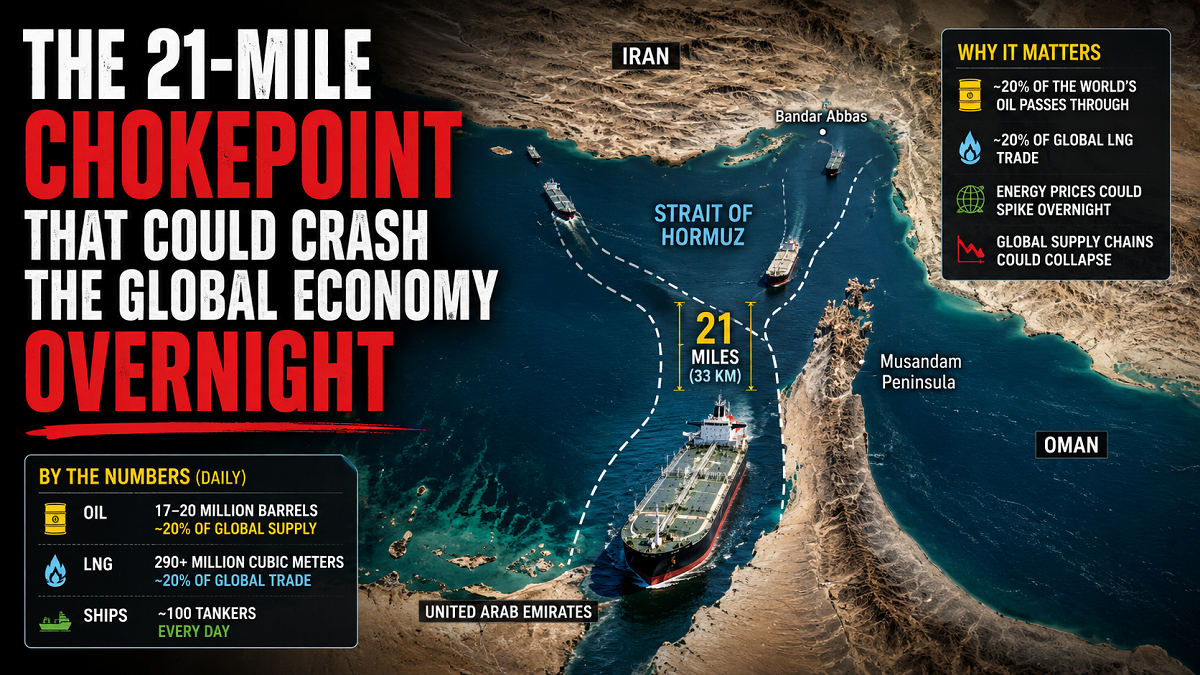

Strait of Hurmuz The 21-Mile Chokepoint That Could Crash the Global Economy Overnight
Imagine for a moment that the world’s economy is a human body. The Suez Canal and the Panama Canal are important veins. The global shipping lanes are arteries. But the Strait of Hormuz? That is the carotid artery—the one that, if pinched, causes instant blackout.
At its narrowest point, the Strait of Hormuz is just 21 miles (33 kilometers) wide. That’s less than the distance from Manhattan to Newark. Yet through this sliver of turquoise water between Oman and Iran passes one-fifth of the world’s daily petroleum consumption. Every day, about 20–21 million barrels of crude oil and condensate slip through these waters, along with a growing share of the planet’s liquefied natural gas (LNG).
If that flow stops—by a tanker accident, a mine, or an act of war—the global economy doesn’t just stumble. It plummets.
The Numbers That Should Keep You Awake
To understand the fragility, look at the raw data. According to the U.S. Energy Information Administration, nearly 30% of all seaborne-traded oil passes through Hormuz. That is roughly 20% of every barrel consumed on Earth. For Qatar, almost 100% of its LNG exports—enough to power entire countries like the UK and Italy—must exit via the same strait.
But the real shock is what happens after Hormuz. Most of that oil heads straight to the “refining capital of the world”: the Persian Gulf refineries in Saudi Arabia (Ras Tanura), the UAE (Ruwais), and Kuwait (Mina Al Ahmadi). Those refineries produce the diesel, jet fuel, and gasoline that Asia and Europe depend on. So a closure wouldn’t just stop crude—it would stop the refined products that keep trucks, planes, and ships moving.
In 2019, when mysterious limpet mines damaged four tankers near Fujairah (just outside Hormuz), oil prices spiked 3% in one day. That was a minor scare. An actual closure would send Brent crude from 80to200 or even $300 per barrel within weeks.
The Domino Effect: From Gas Pumps to Riots
Let’s walk through the first 72 hours after Hormuz is blocked—say, by Iran’s Islamic Revolutionary Guard Corps (IRGC) acting on a threat they’ve made dozens of times.
Day 1: Maritime insurers declare the strait a “war risk zone” and stop covering tankers. Tanker captains refuse to enter. Oil futures markets panic. By noon GMT, crude jumps 50%. Governments from New Delhi to Brussels hold emergency meetings.
Day 3: Japan, South Korea, and China—which source nearly 80% of their oil through Hormuz—announce they have fewer than 60 days of strategic reserves left. Panic buying empties gas stations in Mumbai, Shanghai, and Los Angeles. Diesel shortages idle fishing fleets in the Indian Ocean and tractor fleets in Ukraine.
Week 2: Aviation fuel scarcity grounds 15% of global flights. Chemical plants in Germany that rely on naphtha from the Gulf begin shutting down. In Egypt, bread subsidies collapse when transport costs triple—history has taught us that bread riots can bring down governments.
Month 1: Global GDP contracts by an estimated 5% in a single quarter—worse than the 2008 financial crisis and on par with COVID-19’s first wave, but without any stimulus tools left unused. Emerging economies that cannot afford to bid for remaining oil simply freeze. Pakistan, Bangladesh, and much of sub-Saharan Africa face blackouts and food shortages.
This is not hyperbole. The U.S. Department of Energy once war-gamed a 30-day Hormuz closure. Their conclusion: a “severe recession in virtually every oil-importing country” and a “loss of more than 15 million barrels per day from global markets – a gap that no spare capacity anywhere could fill.”
Why Alternatives Are a Fantasy
A common question: Can’t we just bypass Hormuz? The short answer is no—not quickly, not cheaply, not safely.
-
The UAE’s Abu Dhabi Pipeline can move about 1.5 million barrels per day from Habshan to Fujairah, bypassing the strait. That sounds good until you realize the strait moves 20 million. It’s a garden hose trying to replace a fire hydrant.
-
Saudi Arabia’s East-West Pipeline (Petroline) carries about 5 million bpd from the Gulf to the Red Sea. But that capacity is often fully used for domestic consumption and European exports. Even if it were empty, you’d still have a 15-million-bpd hole.
-
Trucking? Not even worth calculating. You’d need 300,000 tanker trucks running 24/7 to move 1 million barrels. The highway from Riyadh to Jeddah would look like a parking lot for years.
The Geopolitical Tinderbox
Hormuz isn’t just an economic choke point; it’s a political hair trigger. Iran sits on its northern shore, and for decades, Tehran has threatened to close the strait in response to sanctions or military strikes. The IRGC has practiced “swarm attacks” with hundreds of small speedboats, mines, and anti-ship missiles. Their doctrine is simple: If we cannot sell our oil, no one will.
Meanwhile, the United States Fifth Fleet is based just across the water in Bahrain, with aircraft carriers, destroyers, and submarines. Any Iranian attempt to block the strait would likely draw a devastating U.S. military response. That response could escalate into a full Gulf war, potentially involving missiles, drones, and attacks on Saudi and Emirati oil fields. In that scenario, even if the strait reopened, the infrastructure that feeds it would be in flames.
The Silent Killer: LNG
We talk about oil, but the Achilles’ heel might be natural gas. Qatar, the world’s largest LNG exporter, sends its supercooled gas through Hormuz to Europe and Asia. If the strait closes, Europe loses 15% of its gas imports overnight. During winter, that would be catastrophic—hospitals, heating, power grids all strained. In 2022, when Russia cut gas to Europe, prices jumped 800%. A Hormuz closure would dwarf that.
Could It Actually Happen?
Yes. And the warning signs are accumulating. Iran has already seized or harassed more than a dozen tankers since 2019. In 2023–2024, Iranian-backed Houthi rebels in Yemen expanded their missile range into the southern Red Sea and Gulf of Aden, but the core threat remains Hormuz. Tehran knows that even a 24-hour “temporary” closure—perhaps disguised as a naval exercise—would send oil to $150 a barrel, crashing Western economies while Iran’s leaders chuckle from behind their desks.
The only reason it hasn’t happened is that Iran also needs the strait to export its own oil (though sanctions have reduced that flow). But if the regime feels cornered—for example, by an Israeli attack on its nuclear facilities—they have repeatedly signaled they will pull the trigger.
Conclusion: The 21-Mile Asymmetry
We live in a world of supersonic missiles, AI-driven hedge funds, and satellites that can read a license plate from space. Yet the entire global energy system still relies on a 21-mile gap that any small navy could block with a few mines and some determination.
Diversification is slow. Renewable energy is growing, but hydrocarbons still power 80% of world transport and 60% of electricity. Until that changes, the Strait of Hormuz will remain the world’s most dangerous chokepoint—not because of its size, but because of what fits through it: the fragile, invisible, and irreplaceable flow that keeps civilization running.
Next time you fill up your car or turn on a light, spare a thought for that narrow strip of water. It’s only 21 miles across. But it holds the global economy hostage every single day.
